This post contains affiliate links. If you book through them, I may earn a small commission at no extra cost to you it helps keep ESLA running. You can read ESLA’s privacy policy here. Thank you!
As a millennial who grew up on a diet of Charmed, The Craft and Sabrina the Teenage Witch, the subject of witches and witch trials is very close to my heart. No wonder I have so many witchy travel guides here! I am also a feminist so it annoys me that “witch” is still thrown at women as an insult when they are too loud, too independent, too powerful. Look at who was actually accused in these trials: healers, widows and neighbours who did not fit in. The word was turned into something shameful and I would love to take it back. I’m always looking for witch museums, memorials and shops wherever I go, so I thought I’d put together this guide in case you’re interested as well.
Europe’s witch trials killed tens of thousands of people over a few centuries and the places that remember them are scattered across the continent: a former hospital in northern Spain, a weigh house in a Dutch town, a memorial on an island at Norway’s far north-eastern tip. This guide covers 13 witch museums and memorials in Europe. Some where you can learn what happened and see the objects and records that survive. Others to learn about actual witches, paganism and witchcraft.
Some are proper museums with audio guides and gift shops. Others are small exhibitions inside castles or town houses or open-air memorials. I have split them into two groups: places that focus on the witch trials themselves and museums of witchcraft and folklore.
If you came looking for the Salem Witch Museum that one is in Salem, Massachusetts, USA. I went there a few years ago on a quick trip to Boston but it’s not on this list. Everything below is in Europe.
Of course, this information can change. I try to give the most up-to-date information but, if you decide to visit any of these witch museums and memorials, make sure to double check they’re still there!
Quick Guide: Witch Museums in Europe
Where: 13 places across 11 countries from Iceland to Spain
Getting there: mostly small towns and villages. Several are easiest by car so check the transport notes in each entry
Currency: varies by country (pounds, euros, Danish kroner, Swiss francs, Icelandic króna and Norwegian kroner)
Best time to visit: autumn is the obvious pick but many small museums keep seasonal or limited hours so check before you go
Don’t miss: HEX! in Ribe, being weighed at the Heksenwaag in Oudewater and the Steilneset Memorial in Vardø
Witch Museums and Memorials in Europe at a Glance
| Place | Country | Type |
|---|---|---|
| HEX! Museum of Witch Hunt, Ribe | Denmark | Witch trials museum |
| Heksenwaag, Oudewater | Netherlands | Witch trials museum |
| Hexenbürgermeisterhaus, Lemgo | Germany | Witch trials museum |
| Zugarramurdi Witch Museum | Spain | Witch trials museum |
| Riegersburg Castle Witches Museum | Austria | Witch trials museum |
| Burg Hohenwerfen | Austria | Castle exhibition |
| Maison des Sorcières, Bergheim | France | Exhibition space |
| Steilneset Memorial, Vardø | Norway | Memorial |
| Museum of Witchcraft and Magic, Boscastle | England | Witchcraft museum |
| Edinburgh Museum of Magic & Witchcraft | Scotland | Witchcraft museum |
| Museum of Icelandic Sorcery and Witchcraft, Hólmavík | Iceland | Witchcraft museum |
| Museo delle Streghe, Peio | Italy | Folklore museum |
| Hexenmuseum Schweiz, Gränichen | Switzerland | Witchcraft museum |
Why Did Europe Hunt Witches? The Short Version
Witch hunts in Europe peaked in the 16th and 17th centuries although trials happened before and after. Accusations followed bad harvests and plague and quarrels between neighbours and religious conflict. Most of the accused were women. Punishments varied by place: burning was common across much of the continent while England hanged those convicted. Historians disagree on exact numbers but tens of thousands of people were executed. Many of the sites below show how ordinary the accused were: herbalists and healers and neighbours who had fallen out with the wrong person.
Witch Museums and Memorials Dedicated to the Witch Trials
HEX! Museum of Witch Hunt in Ribe, Denmark
Start with HEX! if you only pick one museum from this list. It sits in Ribe in southwest Jutland (a town often described as Denmark’s oldest) and it covers the witch hunts in Denmark and across Europe. Expect historical artefacts and reconstructions alongside interactive displays that show how the hunts spread across the continent. Documentary films follow two women convicted as witches including Maren Spliids, Denmark’s best known convicted witch, who was executed in 1641. Audio guides add context.
The museum is at Sortebrødregade 1 and is not recommended for young children because of the subject matter.
Heksenwaag in Oudewater, Netherlands
Oudewater’s weigh house is the most interactive stop on this list because you can be weighed on the original scales. The belief at the time was that witches weighed almost nothing because they could fly on broomsticks so anyone who came out too light was branded guilty. Oudewater was different. Its scales were accurate and a normal weight meant you were not a witch so the accused left with an official certificate of innocence in a period when fair treatment was rare. Visitors today can still be weighed and receive a certificate.
The museum’s exhibition ANDERS?! links the hunts to modern exclusion and cyberbullying. It is at Leeuweringerstraat 2 in a small town between Utrecht and Gouda. In summer it has been open Tuesday to Sunday from 11:00 to 17:00 so check the website before you set off.
Hexenbürgermeisterhaus in Lemgo, Germany
The name translates as the Witch Mayor’s House. It belonged to Hermann Cothmann, mayor of Lemgo from 1667 to 1683, who led the town’s witch hunts. Historians believe his real aim was to remove political rivals. The house is a Weser Renaissance townhouse built between 1568 and 1571 by a merchant called Hermann Kruwel. It opened to the public in 1926 and became a museum in 2007.
Lemgo’s witch hunts ran from 1583 to 1681. The museum shows torture instruments from the estate of the town executioner’s family alongside modern replicas. You will find it at Breite Strasse 19 in the town centre.
Zugarramurdi Witch Museum in Navarra, Spain
The 1610 trial of Zugarramurdi is described as the greatest witch hunt in Spain. The village sits around 80 kilometres from Pamplona and the museum opened in 2017 inside a former hospital. The first floor focuses on María Ximilegui, who first took part in alleged rituals and then denounced them and set the persecution in motion. The second floor explores the patriarchal society of the time and the figure of the herbolera, the herbalist woman who made natural remedies.
The caves nearby are where the Inquisition believed pagan rituals took place so visit both if you can. A hire car is the easiest way to get here from Pamplona.
Riegersburg Castle Witches Museum in Styria, Austria
Riegersburg is a castle on a rock in the Styrian hills east of Graz and its Witches Museum was redesigned in 2017 with video and sound installations. It looks at the Styrian witch trials of the 17th and 18th centuries when around 300 people were accused of witchcraft or sorcery. The best known story is Katharina Paldauf, the castle keeper’s wife, who was caught up in the largest Styrian witch trial of 1673 to 1675 in Feldbach and became known as the Flower Witch of Riegersburg.
The museum is part of a visit to the castle so you get a dramatic setting as well. It has been open daily from 10:00 to 17:00 in season so check dates before you travel.
Burg Hohenwerfen in Salzburg, Austria
Hohenwerfen is a castle above the village of Werfen south of Salzburg and it is better known for falconry demonstrations and as a filming location for Where Eagles Dare. Inside the old armoury is the exhibition The Legend of Jackl: Wizards and Witches in Salzburg. It covers the Zaubererjackl trials of 1675 to 1679 in which, according to the exhibition, 198 people were accused of practising witchcraft and 138 were executed. A 3D holographic re-enactment of an interrogation makes the trial records feel uncomfortably real.
This is an exhibition inside a castle rather than a stand-alone museum so check the castle website for current opening times and tickets.
Maison des Sorcières in Bergheim, Alsace, France
The Maison des Sorcières is an exhibition space rather than a traditional museum. Bergheim’s historical society created it in 1997 to document the 40 witchcraft trials held in the town between 1582 and 1683. The ground floor explains the historical context of Alsace and Bergheim while the first floor goes through the trials using engravings and archive documents and film. Texts are in French and German.
You will find it at 5 rue de l’Église. Bergheim sits on the Alsace Wine Route so it pairs well with a wine tasting and in December with the Alsace Christmas markets.
Steilneset Memorial in Vardø, Norway
Steilneset is a memorial rather than a museum and it is the most moving place on this list. It stands on the island of Vardøya at the far north-eastern tip of Norway and honours the 91 people (77 women and 14 men) executed for witchcraft in Vardø between 1601 and 1692.
It has two parts. The architect Peter Zumthor designed a long wooden corridor of about 125 metres with 91 windows and a lamp for each victim. The artist Louise Bourgeois created a smoked glass cube holding a chair with flames called The Damned, The Processed and the Beloved. The memorial was completed in 2011.
Vardø is remote so plan flights and onward travel well ahead. If you want to read around the history two novels are set there: The Mercies by Kiran Millwood Hargrave and The Witches of Vardø by Anya Bergman.
Witchcraft and Folklore Museums in Europe
These five focus more on magic and folk belief than on the trials but they all touch on the persecution too.
Museum of Witchcraft and Magic in Boscastle, Cornwall
This is the best known witchcraft museum in the UK and it sits in the harbour village of Boscastle on the north Cornwall coast. There is no train station nearby so a car is the easiest way to get here. The whole of Boscastle if very witchy, in fact! It’s one of my favourite magical places to visit in Cornwall.
It pairs well with the other places in my witchy and mystical places in the UK guide.
Edinburgh Museum of Magic & Witchcraft in Scotland
The museum sits in Chalmers Close just off the Royal Mile. Its collection includes a 17th-century mummified cat and what the museum describes as the world’s oldest Ouija board plus voodoo dolls and objects linked to Scotland’s witch trials. It also runs witch walking tours at weekends and tarot readings so check the website for current times and prices.
It’s very tiny! It’s literally one small room but it’s very interesting and small enough you can squeeze in a visit if you’re short on time.
I cover the rest of the city’s witchy side in my witchy Edinburgh guide.
Museum of Icelandic Sorcery and Witchcraft in Hólmavík, Iceland
This museum in the Strandir region of the Westfjords documents the witch hunts in Iceland with sections on early court cases and the people who were executed. It also covers Icelandic sorcery and magic including magical staves and historical grimoires and old Norse customs such as the blood cup. The museum is at Höfðagata 8-10 and has a restaurant called Galdur on site.
It has kept longer daily hours in summer from mid May to the end of September and shorter hours in winter. The last entry is at 17:30 so check the website before you plan your day. Hólmavík is best treated as part of a Westfjords road trip. My Reykjavik city guide covers where to start.
Museo delle Streghe in Peio, Trentino, Italy
This is a tiny museum in the Val di Sole area of Trentino. It fits around 400 exhibits into just 35 square metres and explores how the theme of witchcraft shaped the beliefs of the farming and herding communities of the valley. The museum says it is one of only seven like it in the world. Visit Trentino lists it as suitable for families. Opening details are not published on the tourism page so contact the museum or the Val di Sole tourist office before you go.
Hexenmuseum Schweiz in Gränichen, Switzerland
Switzerland’s witch museum is inside the Liebegg castle at Liebegg 2 in Gränichen. It has more than 1,300 exhibits across themed rooms on magic and amulets and divination and folklore and healing as well as the history of persecution in Switzerland and Europe and modern witchcraft. It also looks at how witch-related words and superstitions survive in everyday speech.
Opening hours are limited: Wednesdays and Sundays from 13:00 to 17:00 plus some extra Sundays and full moon and new moon evenings. Check the museum website before you visit. The building is a protected castle so accessibility is limited.
Witch Trial Memorials in Scotland and Pendle
Britain has fewer witch museums than the rest of Europe but it has some of the most moving memorials. Scotland held far more trials per head than England. Around 2,500 people were convicted under the Witchcraft Act 1563 and roughly nine in ten were women. If you are building a UK trip around this topic these are the places to add.
Scotland: memorials and the fight for a pardon
In March 2022 Nicola Sturgeon apologised on behalf of the Scottish Government on International Women’s Day. The campaign group Witches of Scotland is still pushing for two more things: a legal pardon for everyone convicted and a national memorial. A pardon bill was lodged in the Scottish Parliament in June 2022 but it was withdrawn in April 2023 when its sponsor became a minister because ministers cannot advance members’ bills. As far as I can find the pardon has not been passed so check the Witches of Scotland website for the latest before you publish. A tartan honouring the accused was registered in January 2025 and Kelty in Fife has been named as a possible site for the national memorial.
Until that exists these are the places you can visit:
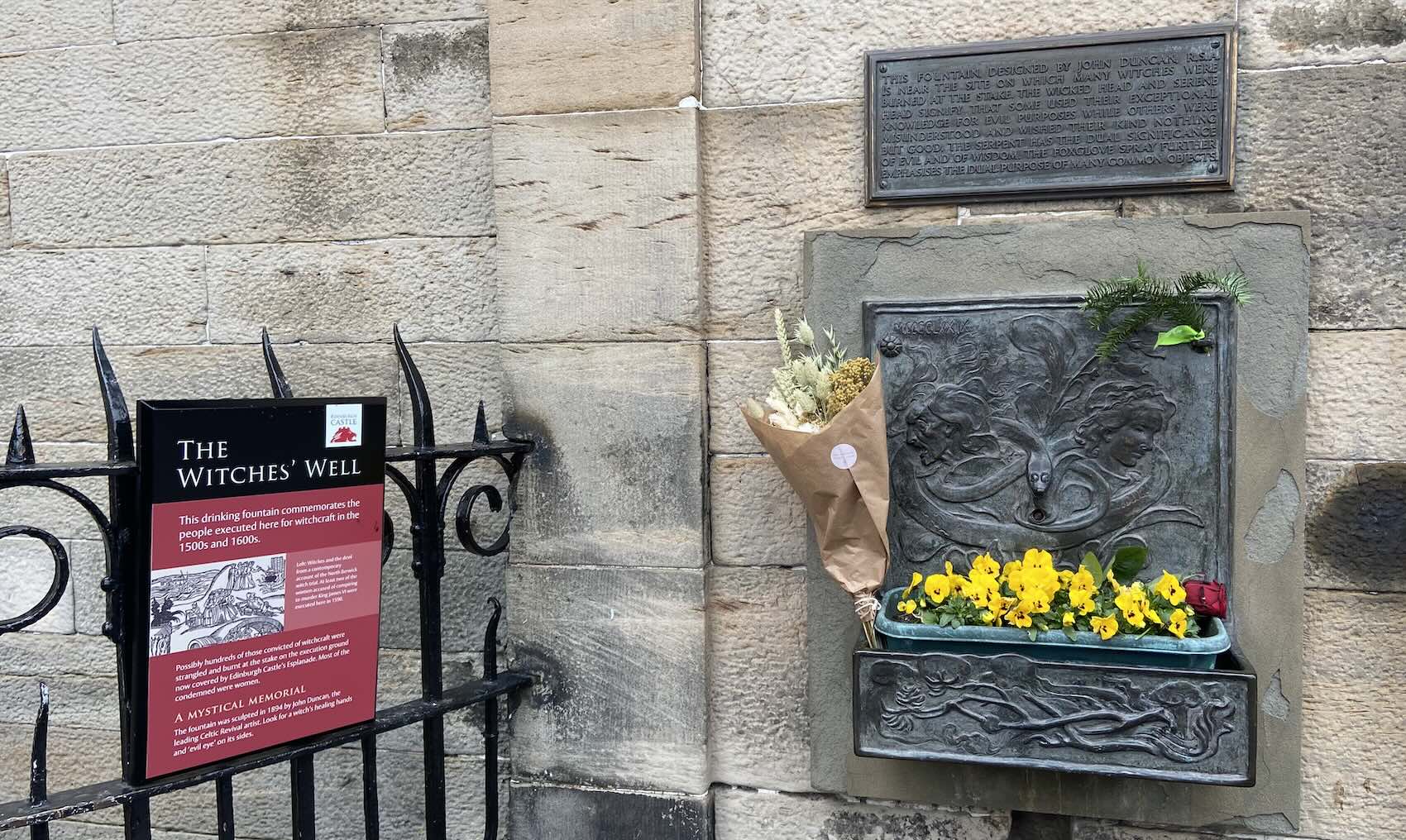
- Witches’ Well in Edinburgh: a small fountain on the Castle Esplanade near where people were burned. The plaque dates from 1912 and historians point out that its wording suggests the accused had real powers when they were victims of persecution. It’s not far from the Edinburgh Museum of Magic and Witchcraft!
- Grissel Jaffray memorial in Dundee: a mosaic in the pavement and a wall plaque near the Seagate marking the woman who was executed in 1669.
- Lilias Adie’s grave in Torryburn: a large stone slab on the shore in Fife marking where she was buried after accusations in 1704.
- Witches Stone on Cluny Hill in Forres: a large stone split in three with a memorial plaque.
If you’re interested in learning more about the witches of Scotland, you can pick up the book How to Kill a Witch. There are also fiction witch books set in Scotland and inspired by the witch trials: the beautifully written Hex, which is very short and The Last Witch of Scotland, which was inspired by the true story of the last person to be tried as a witch in Britain.
More on Witchy Scotland:
Pendle: the Alice Nutter statue and the Witch Trail
The Pendle witches were ten people from the villages around Pendle Hill in Lancashire who were found guilty at Lancaster in 1612. Roughlee has a sculpture of Alice Nutter, one of the accused. It stands on Blacko Bar Road between Crowtrees and Roughlee and was unveiled on 28 July 2012 for the 400th anniversary. It was made from brass and Corten steel by local artist David Palmer.
To see the wider story follow the Pendle Witch Trail. This is a 45 mile self-guided route by car or bike between Lancaster Castle (where the trial took place) and the villages under Pendle Hill. Stops include Barrowford and its Pendle Heritage Centre then Roughlee then Newchurch then Barley then Downham and Clitheroe. I could not find any other formal memorial in Pendle so the statue is the one to aim for. My guide to the Pendle witches has the full story and the best way to get there from London.
ICYMI: Pendle Hill Witches, History and Trail
Books About the Witch Trials to Read Before You Go
These are the ones I would put in a suitcase before visiting any of the places above.
- The Last Witch of Langenburg by Thomas Robisheaux: a historian’s account of a 1672 case in a German village where a woman and her mother were accused after a neighbour died following cakes they had delivered. It shows how an ordinary quarrel could become a death sentence.
- Witch Hunt: A Traveler’s Guide to the Power and Persecution of the Witch by Kristen J. Sollée: half history and half travel guide to sites of persecution so it works as a companion to this post.
- The Mercies by Kiran Millwood Hargrave: a novel set in Vardø in 1617 after a storm kills the fishermen. Read it before visiting Steilneset.
- The Witches of Vardø by Anya Bergman: another novel inspired by the same Norwegian trials.
- Caliban and the Witch by Silvia Federici: a feminist history that links the witch hunts to the control of women’s bodies and work. It is denser than the others but it fits the reason I wanted to write this post.
- In Defence of Witches by Mona Chollet: a French bestseller (published in the US as In Defense of Witches) that follows how the witch hunts shaped the way women are still judged today for being independent or childfree or simply too much.
How to Plan a Witch Museum Trip in Europe
Check opening hours before you go
Many of these are small museums run on seasonal or limited hours. The Hexenmuseum Schweiz opens only a few days a week and Zugarramurdi and Oudewater change their hours by season.
Pair them into routes
Riegersburg and Hohenwerfen make a natural Austria trip although they are in different regions so allow a half day of travel between Graz and Salzburg. Bergheim in Alsace and Gränichen in Switzerland are within a long day’s drive of each other. A northern Europe rail trip could take in Oudewater and Lemgo and Ribe.
Go in autumn but plan for the weather
October is the natural time for this kind of trip and my guide to the best places to visit in Europe in autumn has ideas to combine with it. Pack warm layers and a waterproof jacket: my Europe packing checklist covers the basics.
Be respectful
These were real people who were tortured and killed. Follow any photography rules and keep your voice down in the memorials.
FAQ: Witch Museums in Europe
For the trials themselves HEX! in Ribe is the one I would start with. For something hands-on try being weighed at the Heksenwaag in Oudewater. For witchcraft and folklore head to the Museum of Witchcraft and Magic in Boscastle.
Yes there are two on this list: the Museum of Witchcraft and Magic in Boscastle in Cornwall and the Edinburgh Museum of Magic & Witchcraft in Scotland.
Trials took place from Scandinavia to Spain and are most associated with the 16th and 17th centuries. The places on this list show how different each country’s experience was.
Yes. The Heksenwaag in Oudewater still lets visitors be weighed on the original scales and gives them a certificate.
It depends on the museum. HEX! in Ribe is not recommended for young children while Visit Trentino lists the Museo delle Streghe in Peio as suitable for families. Check each museum before you go.
No. The Salem Witch Museum is in Salem in Massachusetts in the United States.
Autumn suits the theme but many small museums have seasonal hours so check opening times before you plan your route.