Britain has an almost unreasonable (in the best sense!) number of stone circles. More than 1,000 survive across Britain and Ireland, scattered over moorland, farmland, clifftops and the odd village green and most of them are free to visit. Some are world famous, like Stonehenge and Avebury. Others sit at the end of a muddy footpath with nothing but a few sheep for company. So much so there was one in particular I visited but couldn’t remember for the life of me where it was! I just scoured the photos on my phone to find it: Tomnaverie in Aberdeenshire!
This guide covers the best stone circles in the UK, grouped by region so you can build a route around them. It’s for anyone who loves a bit of folklore with their sightseeing, whether you’re planning a road trip, a day out from London or a witchy weekend away. For each circle you’ll find the legend that goes with it, how to get there and what to see nearby. Almost every story ends the same way, with someone turned to stone for doing something they shouldn’t (usually dancing on a Sunday).

This post contains affiliate links. If you book through them, I may earn a small commission at no extra cost to you it helps keep ESLA running. You can read ESLA’s privacy policy here. Thank you!
Quick Guide: Stone Circles in the UK
📍 Where: Across England, Scotland, Wales and Northern Ireland, with the biggest clusters in Cornwall, Dartmoor, the Lake District, Wiltshire, Aberdeenshire and Orkney
🚗 Getting there: A car is the easiest way to reach most of them. Stonehenge and Avebury work as day trips from London by train plus bus or tour, and Castlerigg and the Twelve Apostles can be walked to from Keswick and Ilkley
💷 Currency and cost: Pounds sterling (£). Most circles are free to visit. Stonehenge is ticketed and needs booking in advance
🗓️ Best time to visit: May to September for long days and easier walking. Autumn mornings for mist and quiet. The summer and winter solstices at Stonehenge and Avebury
✨ Don’t miss: Avebury for sheer scale, Castlerigg for the mountain setting, the Merry Maidens for the folklore and the Ring of Brodgar for the drama
⚠️ Heads up: Many circles are on farmland or open moor. Wear proper boots, take a waterproof and stick to the paths
What Were Stone Circles Used For?
Nobody knows for certain and the mystery is what makes them so fascinating. Most British stone circles were built between roughly 3000 BC and 1500 BC, during the Neolithic and Bronze Age, by people who left no written records. Archaeologists have a few leading theories:
- Ceremony and ritual: gathering places for seasonal festivals, funerals or offerings
- Astronomy: many circles line up with the solstices, equinoxes or the movements of the moon, which suggests they worked as calendars
- Burial and ancestors: human remains have been found at or near several circles and some may have been built to honour the dead
- Community and status: moving and raising enormous stones took hundreds of people working together, so building a circle may have been as much about bringing communities together as any single belief
The medieval explanation was simpler. People assumed these were the work of giants, the devil or witches or that the stones were once people frozen in place as punishment. Those legends are what you’ll find attached to most of the circles below.
Stone Circles in Wiltshire
Wiltshire is the obvious place to start and it’s the easiest region to reach from London. If you’re building a witchy route, my witchy places in the UK guide has more on Avebury and the landscape around it.
Avebury
Avebury is the largest stone circle in Britain and widely described as the largest in the world. The henge is so big that a village grew up inside it, so you end up walking between ancient stones, a church, a pub and a handful of houses. Unlike Stonehenge, you can wander freely among the stones and there’s no ticket or fence.
The outer circle is roughly 330 metres across and once held an inner pair of circles too. Silbury Hill, the largest man-made prehistoric mound in Europe, and West Kennet Long Barrow, a Neolithic burial chamber you can walk into, are both within a few minutes’ drive, so give yourself a full day.
Getting there: There are bus services to Avebury from Swindon, Devizes and Marlborough. For day trips from London, many people take the train to Swindon and continue by bus or taxi. A guided tour from London or Bath is the simplest option if you don’t want to organise connections (and they also take you to Stonehenge below!).
Looking for somewhere to stay nearby? Check Booking.com for B&Bs and inns in Avebury, Marlborough and Devizes.
MAGIC IN THE UK: 10 Witchy Places to Visit in the UK
Stonehenge
Stonehenge needs no introduction, but it does need planning. The monument was built in stages from around 3000 BC and the famous sarsen circle with its stone lintels dates to roughly 2500 BC. The sarsens came from about 15 miles away, while the smaller bluestones were brought from the Preseli Hills in Wales, a journey of roughly 150 miles. The Altar Stone, which lies at the centre, turned out to come from north-east Scotland, more than 450 miles away, which is the longest known stone journey for any Neolithic monument.
What you see today isn’t entirely untouched. Many of the stones had fallen or were leaning by the 19th century and they were straightened, re-erected and set in concrete in several rounds of restoration between 1901 and 1964. That doesn’t make it any less impressive and the stones are in their original positions as far as archaeologists can tell, but it’s good to know before you go.
You can’t walk among the stones on a standard visit, but you can walk around the circle on a path and see them up close. Tickets are timed and sell out, so book ahead, particularly in summer. Both solstices bring open access and large crowds.
Getting there: The nearest station is Salisbury, about 1 hour 30 minutes from London Waterloo, with a shuttle bus from the station to the site. Day tours from London run daily and often combine Stonehenge with Bath or Windsor.
Book Stonehenge tours from London on GetYourGuide or compare options on Viator.
ENGLAND BEYOND LONDON: Best Day Trips From London by Train or Tour
Stone Circles in Cornwall
Cornwall has some of the most atmospheric stone circles in the UK, mostly because they sit in wild, windswept landscapes with the sea never far away. If you’re planning a longer trip, my magical places in Cornwall guide might be helpful to you.
The Merry Maidens
Also known as Dans Maen (the stone dance), the Merry Maidens is a ring of 19 granite stones in a field near St Buryan, west of Penzance. The legend says that nineteen maidens were dancing on a Sunday when they were turned to stone for breaking the Sabbath. Two standing stones in nearby fields, known as the Pipers, are the musicians who suffered the same fate.
The circle is almost perfectly round and sits beside a lane, so it’s one of the easiest to visit in Cornwall. Combine it with Land’s End, Minack Theatre and the tiny coves along the Penwith coast.
Getting there: A car is easiest. Limited bus services run from Penzance to St Buryan, but check times before you rely on them.
Boscawen-Ûn
A short walk across a field from the road, Boscawen-Ûn is a ring of 19 stones with one tall stone leaning at an angle in the centre. It’s thought to date to the Bronze Age and is still used for ceremonies by Gorsedh Kernow, the Cornish bardic society. It feels more intimate than the Merry Maidens, partly because it’s tucked away from the road and framed by gorse.
You can visit both circles in the same morning, since they’re close to each other near St Buryan.
The Hurlers
Up on Bodmin Moor near the village of Minions, the Hurlers are three stone circles in a row, the only group of this kind in Cornwall. The legend says that men who played the Cornish sport of hurling on a Sunday were turned to stone as a punishment and two standing stones nearby, the Pipers again, are the musicians who played for them.
The setting is the real draw. It’s an open, exposed moor with the Cheesewring, a natural pile of granite slabs that looks like it shouldn’t be standing, a short walk away. The weather changes fast up here, so bring layers. (If you’re a literature fan, the area is the setting for Daphne Du Maurier’s famous book, Jamaica Inn!)
Getting there: Car is easiest. Minions is about 20 minutes from Liskeard, with limited bus services.
Compare places to stay in Penzance, St Ives and Liskeard on Booking.com. I actually stayed in St Austel and drove all around the county!
MAGICAL CORNWALL: Most Magical Places to Visit in Cornwall
Stone Circles on Dartmoor
Dartmoor is packed with prehistoric remains, including stone rows, hut circles and cairns, but the stone circles take a bit more effort to reach than those in Cornwall. If you’re searching for stone circles in Devon, this is where to go.
Scorhill Stone Circle
Scorhill is one of the best-preserved circles on Dartmoor, with around 23 stones still standing in a ring on open moorland near Gidleigh. There’s no signpost and no ticket office, just a footpath across the moor and a view over the Teign valley. It takes a moorland walk of a couple of miles to reach, so go with a map or OS app and check the weather before you set off. Dartmoor mist is no joke.
If you’d like something shorter, Fernworthy Stone Circle near Fernworthy Reservoir is a gentler walk from the forest car park. The Grey Wethers, two circles side by side on the northern moor, are worth adding if you’re a keen walker. Their name comes from their resemblance to sheep resting on the moor.
Getting there: You need a car for Dartmoor. The nearest towns are Chagford and Moretonhampstead.
Stone Circles in the Lake District
Cumbria has some of the oldest and most dramatic stone circles in England. If you’re searching for Lake District stone circles, these are the three to plan around.
Castlerigg Stone Circle
Castlerigg, near Keswick, is the one most people picture when they think of the Lake District. Around 38 stones stand in a ring roughly 30 metres across, with Skiddaw and Helvellyn rising behind them in every direction. It dates to around 3000 BC, which makes it one of the earliest stone circles in Britain. Inside the ring there’s a rectangular setting of stones known as the Cove that nobody has fully explained.
It’s owned by the National Trust and free to visit. Arrive early or at sunset to avoid the crowds, since this is one of the most photographed circles in the UK. I went on a summer day in July a day after climbing Scafell Pike and it was surprisingly not very busy but I think it’s because it was a weekday.
Getting there: It’s about a 1.5-mile walk from Keswick, mostly uphill or a short drive. Keswick has bus connections to the wider Lake District.
Browse places to stay in Keswick on Booking.com. I didn’t stay there…I stayed at an inn in the middle of nowhere near Scafell!
Long Meg and Her Daughters
Near Penrith, Long Meg and Her Daughters is the second largest stone circle in England, with around 59 stones. Long Meg herself stands outside the ring: a tall red sandstone pillar carved with spirals and rings by prehistoric people. The legend says Meg was a witch who was turned to stone by the Scottish wizard Michael Scot and that the stones of the circle are her coven. It’s also said that it’s impossible to count the stones twice and get the same number. If you do, the spell is broken.
Getting there: You’ll need a car or a taxi from Penrith. Langwathby station on the Settle to Carlisle line is the nearest station, but check the walking distance before you plan on it.
Swinside Stone Circle
Swinside, in the quieter southern Lake District near Millom, is a near-perfect ring of around 55 stones, which makes it one of the best-preserved circles in Cumbria. It’s also known as Sunkenkirk, after a legend that the devil kept knocking down the stones as soon as they were built by day. There’s a short walk across fields to reach it and you’re more likely to have it to yourself than Castlerigg.
Stone Circles in Yorkshire and the Peak District
Yorkshire’s stone circles are small and low-key but the moorland setting makes them worth the walk.
The Twelve Apostles, Ilkley Moor
Set on the open moor above Ilkley, the Twelve Apostles is a Bronze Age ring of twelve stones with Wharfedale spread out below. It’s a good option if you want a walk with a payoff and a train connection, since Ilkley has regular trains from Leeds and Bradford. Take a map and check the weather first, because the moor can turn grey and wet very quickly. Ilkley Moor is also known for its cup and ring carvings, which you can find on boulders across the moor.
Nine Ladies, Stanton Moor
Just over the border in Derbyshire, Nine Ladies sits in woodland on Stanton Moor in the Peak District. The Bronze Age circle is small and tucked into the trees, which gives it a more secretive feel than the open-moor circles. The legend says that nine women danced on a Sunday and were turned to stone and a nearby standing stone called the King Stone is said to be the fiddler who played for them.
Getting there: By car is easiest. Matlock is the nearest station and Bakewell is the nearest town of any size.
Stone Circles in Scotland
Scotland has some of the finest stone circles in the UK, from recumbent circles in Aberdeenshire to the monuments of the Western Isles and Orkney. If you’re searching for stone circles in Scotland, start here. My magical places in Scotland guide covers more of the folklore and witchy history along the way.
Aberdeenshire Stone Circles
Aberdeenshire is home to a type of stone circle you won’t find anywhere else in Britain: the recumbent stone circle. Each one has a huge stone lying on its side between two upright flankers, usually on the southwest side of the ring, with the other stones graded in height towards it. They date to around 4,000 years ago and may have been aligned to the moon.
Easter Aquhorthies
Easter Aquhorthies, near Inverurie, is one of the best-preserved recumbent circles in Scotland. The recumbent stone is a massive block of red granite flanked by two pillars, and the circle itself includes stones of red jasper and pink granite that seem to glow in the evening light. It’s looked after by Historic Environment Scotland, free to visit and a short drive from Inverurie.
Loanhead of Daviot
Loanhead of Daviot, a short drive north of Inverurie, is a recumbent circle with a ring cairn inside it, where cremated remains were found. Pair it with Easter Aquhorthies for a half-day Aberdeenshire stone circles trip, and visit Castle Fraser or Crathes Castle on the way back if you have time.
Getting there: A car is needed for both. Inverurie has train connections to Aberdeen.
Tomnaverie Stone Circle
Tomnaverie stands on top of a small hill about a mile south of Tarland, on the road to Aboyne, with the village laid out below. It’s a recumbent circle around 17 metres across, built roughly 4,000 years ago, and the recumbent stone and its flankers on the southwest side are the highlight. Historic Environment Scotland notes that circles like this may once have been used for astronomical observation and there are about 100 recumbent circles in total, all of them in north-east Scotland.
It’s also a restored site. A nearby quarry made the circle unstable and left it in a ruinous state, so it was excavated and restored in 2000, which means what you see is partly reconstructed. It’s free, open year-round and looked after by Historic Environment Scotland.
Getting there: There’s a small car park on the B9094 between Tarland and Aboyne, then a walk of around 250 metres up a path to the circle. Strong footwear is recommended. Easter Aquhorthies is roughly 50 minutes away by car, so the two work well in one day. We got there while driving from Cairngorms to Dunnottar Castle during our week-long Scotland road trip. It was only a 10min detour!
Getting there for the other Aberdeenshire circles: A car is needed for all three. Inverurie has train connections to Aberdeen.
SCOTLAND ROAD TRIP: This Scotland 1-Week Road Trip was one of the best trips of my life! It included this stone circle and Isle of Skye.
Highlands Stone Circles
Clava Cairns
Clava Cairns, about 6 miles east of Inverness near Culloden Battlefield, is a Bronze Age cemetery set in a small wood. Three large burial cairns stand in a line, two of them passage graves and the middle one a ring cairn with no entrance and each is surrounded by its own ring of standing stones. The stones are tallest on the southwest side, and the passages point towards the midwinter sunset, which suggests the sun mattered to the people who built it. The cairns were built around 4,000 years ago and the site was reused a thousand years later, so it was a sacred place for a very long time.
Look closely at the kerbstones and you’ll find cup and ring carvings, which were cut before the stones were built into the cairns. Outlander fans link Clava to Craigh na Dun, the stone circle where Claire travels back in time, which is why it’s now busy with people taking time-travelling photos. There’s also a story that a tourist who took a rock home in 1999 posted it back after a run of bad luck in the family, so leave everything where it is.
It’s managed by Historic Environment Scotland, free to visit and open all year. Go early or near sunset for the best light, and pair it with Culloden Battlefield, which is just along the road. My magical places in Scotland guide covers other stops on a Highlands road trip, including Loch Ness and Glencoe.
Getting there: A car or taxi from Inverness is easiest. Check bus options to Culloden if you’re travelling without one.
Isle of Skye Stone Circles (and Where to Go Instead)
If you’re searching for Isle of Skye stone circles, here’s the helpful bit: Skye has very few visitable ones and none that compare to the circles elsewhere in this guide. The stone circles at the Fairy Glen near Uig are modern, laid out by visitors rather than prehistoric builders, so they’re a fun stop but not an ancient site. I felt like I was on an 80s movie set there! Like Labyrinth or something…
The real Skye story is at Sconser, where archaeologists have recorded around 20 small circular stone alignments in the intertidal zone. They only appear at extreme low tides, for a few hours a year and researchers think they date back around 11,000 years, long before the stone circles in the rest of this guide. Nobody knows what they were for, though one suggestion is that they were used for fish trapping or tidal hunting. You can’t plan a visit around them, but they’re a good reason to think of Skye as one of the earliest inhabited parts of Scotland.
For a proper stone circle, Skye has something even better: a ferry route from Uig to Tarbert, which puts you on the Outer Hebrides, home to one of the most spectacular stone circles in Scotland. My Isle of Skye guide covers the rest of the island.
ISLE OF SKYE: ESSENTIAL STOPS ON THE ISLE OF SKYE
Callanish Standing Stones
The Callanish Standing Stones on the Isle of Lewis were raised around 2900 BC and form a cross-shaped arrangement of stones, with a central ring, a tall central monolith and long avenues of stones stretching out in each direction. Local legend says the stones are giants who refused to convert to Christianity and were turned to stone by Saint Kieran. A nearby ridge of hills known as the Cailleach na Mointeach (the Old Woman of the Moors) is said to look like a sleeping woman when seen from the stones.
Getting there: Take the ferry from Uig on Skye to Tarbert on Harris, then drive roughly an hour to Callanish. You can also reach Lewis by ferry from Ullapool to Stornoway.
Orkney Stone Circles
Orkney is one of the best places in the UK to see Neolithic monuments and its stone circles are part of the Heart of Neolithic Orkney UNESCO World Heritage Site.
Ring of Brodgar
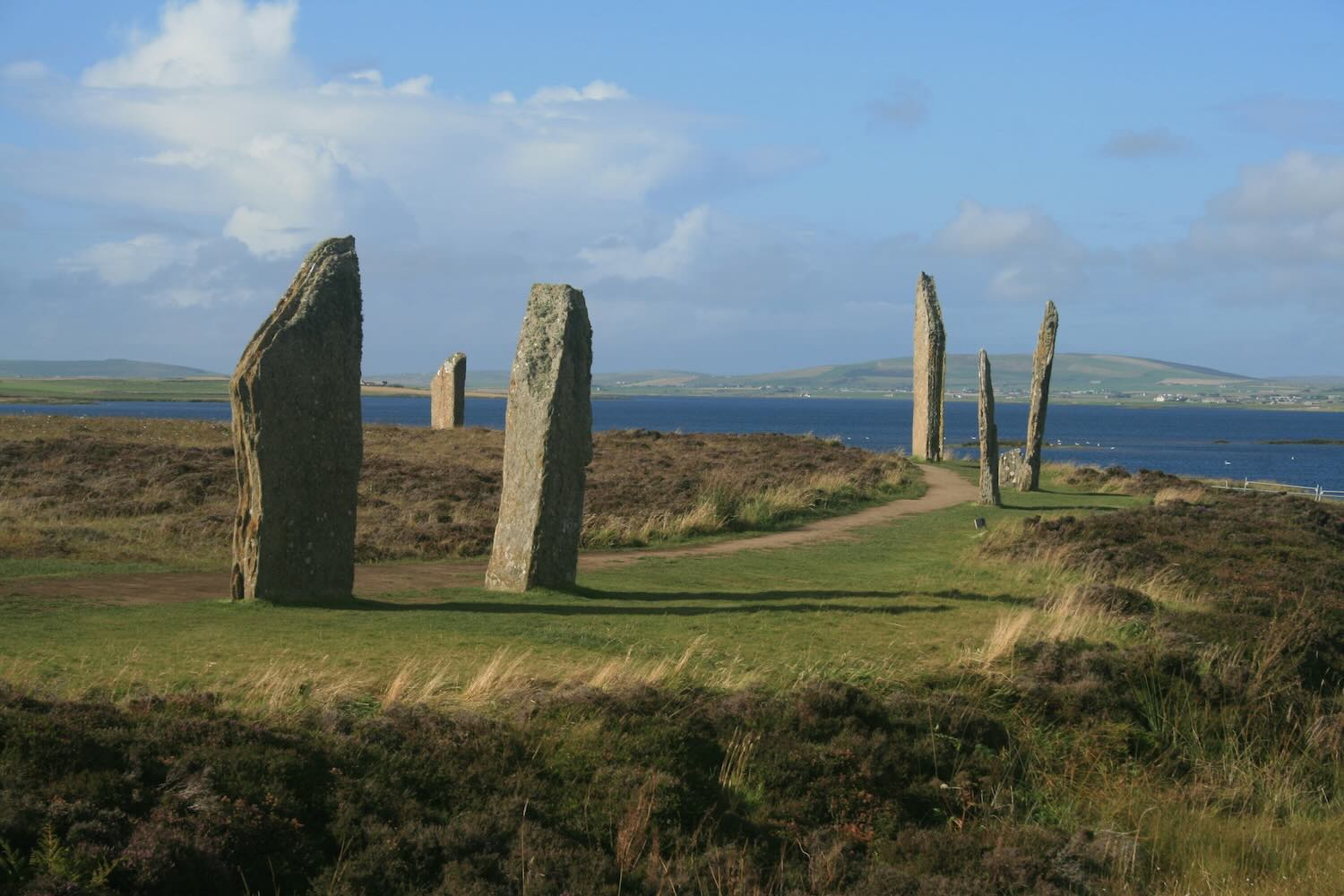
The Ring of Brodgar is a vast circle of upright stones set on a narrow strip of land between two lochs. It’s 104 metres across and 27 of the original stones remain, some of them more than 4 metres tall. A ditch was cut into the bedrock around the ring, which is hard to picture until you stand there and see the scale of the work. Local legend says the stones are giants who danced at sunrise and were frozen in place by the first light.
The nearby Standing Stones of Stenness are older and equally striking and just along the coast you’ll find Skara Brae, a remarkably preserved Neolithic village and Maeshowe, a chambered tomb that lines up with the winter solstice sun. Give yourself at least two days here.
Getting there: Orkney is reached by ferry from Scrabster to Stromness or from John o’ Groats to Burwick (passengers only in summer) or by plane from Aberdeen, Edinburgh and other airports. A car makes life easier, though local buses run between Kirkwall and Stromness near the main sites.
Compare guided tours of Orkney on GetYourGuide or Viator if you don’t want to drive. Search places to stay in Kirkwall and Stromness on Booking.com.
Stone Circles in Wales
Wales has fewer intact circles than England or Scotland, but the ones that survive are special and both of these are easy to combine with a coastal or mountain trip.
Gors Fawr
On the edge of the Preseli Hills in Pembrokeshire, Gors Fawr is a near-perfect circle of 16 stones, about 22 metres across. Eight of them are spotted dolerite, the same bluestone found at Stonehenge and archaeologists have traced it to outcrops in these same hills. A survey found nothing buried beneath it, which suggests it looks much as it did when it was built in the late Neolithic or Bronze Age. It’s small, but it’s one of the best-preserved circles in Wales.
There’s a layby beside the common and the circle is a short walk across open ground, so it’s easy to reach if you have a car. If you’re up for more, the nearby Golden Road follows the ridge towards Bedd Arthur, a horseshoe-shaped setting of stones said to be the burial place of King Arthur. Pentre Ifan, a Neolithic burial chamber, is a short drive away.
Getting there: A car is essential. The nearest villages are Mynachlog-ddu and Crymych.
Compare places to stay in Pembrokeshire on Booking.com.
The Druids’ Circle, Penmaenmawr
High on the moor above Penmaenmawr on the North Wales coast, the Druids’ Circle is an embanked Bronze Age circle roughly 35 metres across, with ten stones still standing and views over Conwy Bay. It’s often called one of the finest stone circles in Wales. The name comes from the idea of Victorian antiquarians, who linked many monuments to the druids. The circle is far older than the druids, though that doesn’t make it any less atmospheric.
A cremation burial was found in the centre when the site was excavated in 1958, so this was a burial monument as well as a gathering place. You’ll need a moorland walk to reach it, so take a map and check the weather before you set off.
Getting there: Penmaenmawr has a station on the North Wales Coast line, so you can reach the town by train and walk up. Check the route on a map first, as it’s a steep climb.
Stone Circles in Northern Ireland
Northern Ireland is packed with stone circles, mainly in County Tyrone and County Down and they’re much less visited than the ones in England or Scotland. A car makes this much easier.
Beaghmore Stone Circles
Beaghmore, on the edge of the Sperrin Mountains in County Tyrone, is a complex of seven stone circles, ten stone rows and twelve cairns. It was uncovered when the peat was cut in the 1930s and 40s, which means most of what you see was buried for thousands of years. The circles date to around 1600 BC, though flint tools and hearths found at the site go back to around 2900 to 2600 BC.
The stones here are small, so don’t expect Castlerigg. The effect comes from the pattern: paired circles, long rows of tiny stones running beside shorter rows of tall ones and a moor that feels very empty. Three of the stone rows point to the sunrise at the summer solstice, which suggests the site worked as a calendar. Nobody really knows what it was for.
The listing from the Department for Communities describes it as open access all year, but it’s worth checking the Mid Ulster visitor page before you go in case anything has changed.
Getting there: A car is essential. It’s about 17 kilometres northwest of Cookstown.
Ballynoe Stone Circle
Ballynoe, near Downpatrick in County Down, is a large and complex circle of around 50 closely spaced upright stones. It’s one of the most striking in Northern Ireland and it’s much easier to visit than the Sperrin sites. Downpatrick is traditionally linked with Saint Patrick, so you can combine the circle with the cathedral and the town’s heritage sites.
Getting there: A car is easiest. Downpatrick is about 30 miles from Belfast.
Browse places to stay in Belfast and County Down on Booking.com.
How to Visit Stone Circles Respectfully
Stone circles are ancient monuments and, for many people, sacred places. A few basics apply almost everywhere:
- Don’t climb on the stones or carve anything into them
- Take your litter home and avoid leaving candles, ribbons or other offerings, which damage the stone and the site
- Stay on paths across farmland and close gates behind you
- Avoid flying a drone unless you’ve checked the site rules
- Go early or late for the best light and the fewest people
How to Plan a Stone Circles Trip
Most of these circles are spread across the country, so it helps to pick a region rather than trying to see everything. Here are a few routes that work well:
- A weekend from London: Stonehenge and Avebury, with a night in Salisbury or Marlborough
- A Cornwall long weekend: the Merry Maidens, Boscawen-Ûn and the Hurlers, with the sea and the Penwith coast as the backdrop
- A Lake District road trip: Castlerigg, Long Meg and Swinside in one loop
- A Welsh weekend: Gors Fawr in Pembrokeshire or the Druids’ Circle above Conwy Bay, each paired with a coastal walk
- A Northern Ireland trip: Beaghmore in County Tyrone and Ballynoe in County Down, with Belfast as a base
- A Scottish road trip: Aberdeenshire’s recumbent circles, Clava Cairns near Inverness, then a flight or ferry on to the islands for Callanish and Brodgar
For trains and coaches between cities, check Omio.
Accommodation, search Booking.com.
For guided tours, including Stonehenge from London and Orkney day trips, look at GetYourGuide and Viator.
If you’re heading to the moors, a good pair of durable walking boots and a waterproof jacket are worth the investment!
Final Thoughts
If you only have time for a few, I’d start with Avebury for the scale, Castlerigg for the setting and the Ring of Brodgar if you can make it north. If you want the folklore, the Cornish circles and Long Meg are the ones with the best stories. Stonehenge is worth seeing once, but book ahead and go early.
The best thing about stone circles is that you can see them in almost any part of the UK and most are free. Pick a region, pack a waterproof and go.
FAQ: Stone Circles in the UK
Nobody knows for sure, but the main theories are ceremony and ritual, astronomy (many line up with the solstices), burial and ancestor worship and community gatherings. Most British circles were built between about 3000 BC and 1500 BC.
More than 1,000 stone circles survive across Britain and Ireland, though only a fraction are as complete or well known as Stonehenge and Avebury.
Avebury in Wiltshire is the largest stone circle in Britain and is widely described as the largest in the world.
The Ring of Brodgar and the Standing Stones of Stenness on Orkney, the Callanish Standing Stones on Lewis, Clava Cairns near Inverness and the recumbent circles at Easter Aquhorthies and Loanhead of Daviot in Aberdeenshire are the ones to prioritise.
Yes, and many of them are among the best in the UK. Avebury, Stonehenge, Castlerigg, Long Meg and Her Daughters, the Merry Maidens and Scorhill on Dartmoor are all in England.
Yes. In Wales, Gors Fawr in Pembrokeshire and the Druids’ Circle near Penmaenmawr are the best known. In Northern Ireland, Beaghmore in County Tyrone and Ballynoe in County Down are the ones to visit.
Not on a standard visit. You can walk around the circle on a path but not among the stones. Avebury is the place to walk freely among the stones, and most other circles on this list are open to wander through.
Most are. Stonehenge is the main exception, as it needs a timed ticket, and a few sites have small car park charges.
Not close by, but Stonehenge and Avebury are both reachable in around two hours by train plus bus or on a day tour.
For most of them, yes. Stonehenge, Avebury, Castlerigg and the Twelve Apostles can be reached with public transport or a walk from a town, but circles on Dartmoor, in Cornwall, Cumbria, Aberdeenshire and Orkney are much easier by car or on a tour.
Enjoyed this? You might also like: