Berlin is a city you could spend weeks in and still not finish. I’ve been there so many times over the years, I still have ground to cover. But some of the best things about visiting are just outside it. Within an hour or two of Berlin Hauptbahnhof you’ve got baroque palaces, canal villages you paddle through by kayak, an abandoned sanatorium and one of the most important places in Germany to understand its history.
Whether you’ve got a car, a rail pass or just a free Saturday and a Deutschlandticket, this covers where to go, how to get there and how long to give yourself.

Quick Guide: Day Trips from Berlin
📍 Best for history: Sachsenhausen Memorial, Wittenberg
🌊 Best for nature: Spreewald, Saxon Switzerland
🏰 Best for palaces: Potsdam, Rheinsberg
🚂 Getting around: Most of these work by train (Deutschlandticket covers a lot of regional routes); a few need a car
🗓️ Best time to visit: Spring to early autumn for canals and hiking, any time for the cities and history sites
🏨 Where to stay in Berlin: (BOOKING_AFFILIATE_LINK)
🚗 Renting a car: (DISCOVERCARS_AFFILIATE_LINK or your usual car hire partner)
Potsdam: The Easy Classic
If you only have time for one day trip, make it this one. Potsdam is the day trip everyone recommends and there’s a reason for it: it’s the least effort for the biggest change of scenery and it comes with a wild piece of 20th-century history attached.
Cecilienhof Palace, in Potsdam’s New Garden, wasn’t even the original plan for one of the most consequential meetings of the 20th century. Berlin was so reduced to rubble by the summer of 1945 that Allied leaders abandoned the idea of holding their post-war summit there. It was a logistical and security nightmare. Potsdam, which had been the residence of the Prussian kings and later the German Kaisers until 1918 (Germany’s answer to what Windsor is to London), was the fallback. So in July 1945, Truman, Stalin and Churchill (later replaced mid-conference by the newly elected Clement Attlee) sat down in the palace’s great hall and redrew the map of post-war Europe. Truman reportedly authorised the bombing of Hiroshima by phone while he was there.
How to get there: Regional trains run frequently from Berlin Hauptbahnhof, taking around 25 minutes.
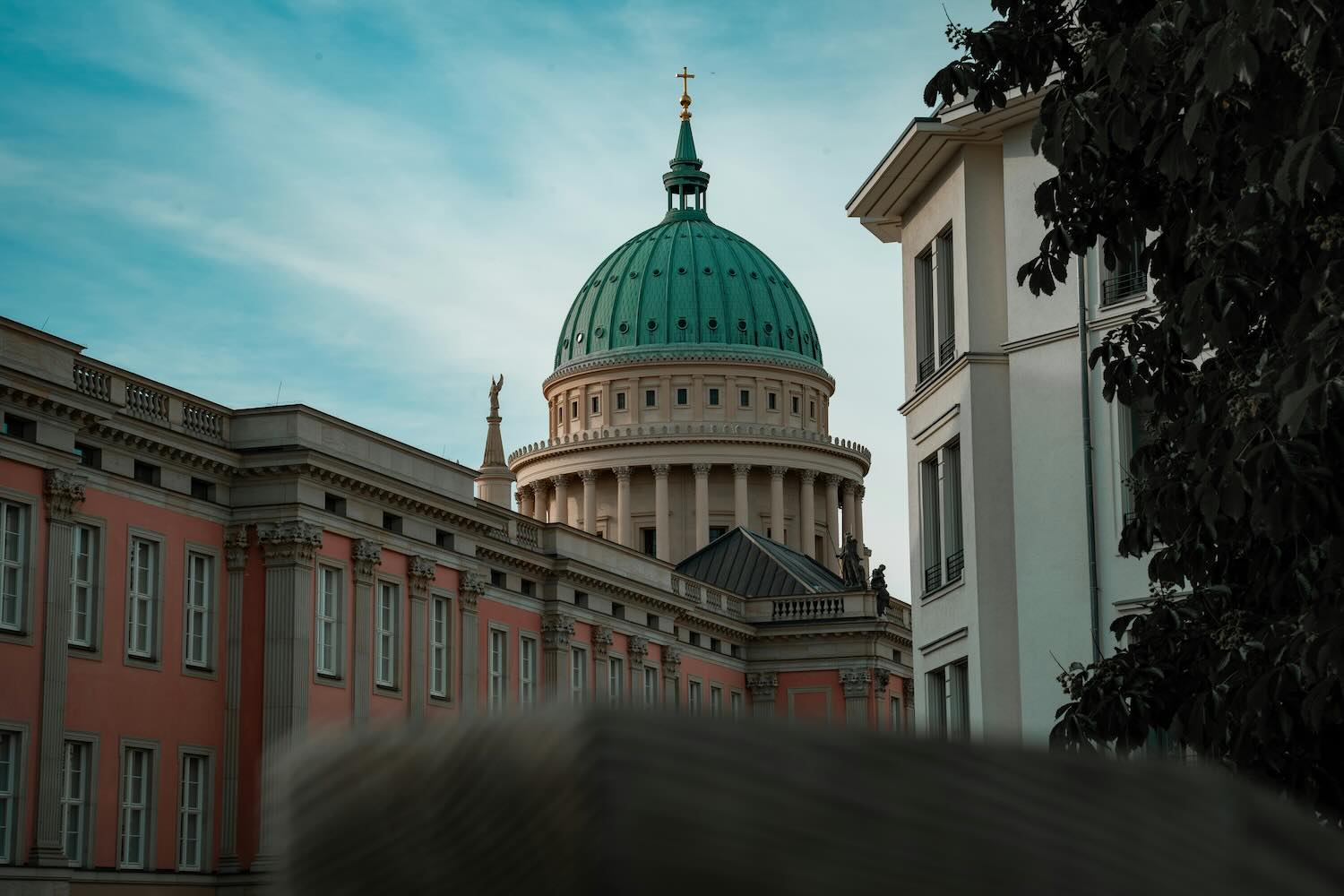
What to see: Sanssouci Palace and its gardens (often called the “Versailles of Germany”), Cecilienhof Palace, the Dutch Quarter, Alter Markt and the Nikolaikirche.
Spandau Altstadt and Citadel: Berlin’s Own Medieval Town

This one barely feels like leaving Berlin, because… well, you’re not exactly leaving, but hear me out! Spandau is technically still part of the city, but it was a separate, significant town in its own right long before Berlin existed with documented city rights. Spandau received its town charter around 1232.
At the heart of it is the Citadel, one of the best-preserved Renaissance fortresses in Europe. Its Julius Tower contains masonry dating back to the 13th century, making it a contender for the oldest surviving structure within Berlin’s modern city limits, built on the site of an even older stronghold at the meeting point of the Havel and Spree rivers.
I went to Spandau Citadel years ago with my brother, purely because it’s the filming location for a scene in Gotcha!, a film we LOVED as kids. Do you know it? I’ve never met anyone who’s seen it. It’s got a very young Anthony Edwards (from ER!).
How to get there: U-Bahn or S-Bahn to Spandau, about 30-40 minutes from central Berlin.
What to see: Spandau Citadel and the Julius Tower, the pedestrianised old town with its half-timbered houses, Brauhaus Spandau for a beer garden lunch.
Leipzig: The Easiest “Proper City” Day Trip
Leipzig doesn’t get talked about as much as Dresden but it’s actually the more convenient of the two. Direct ICE trains take about 70 minutes, so you can have a real full day here without an early start.
It’s also one of the most historically significant cities in modern Germany. The Nikolaikirche, Leipzig’s oldest church, hosted quiet Monday evening “peace prayers” from 1982 onwards, starting with just a handful of people. By autumn 1989 those services had grown to tens of thousands, spilling out into the streets in what became known as the Peaceful Revolution, a full month before the Berlin Wall came down. Bach spent 27 years as the city’s director of music and several of his major works, including the St John Passion, premiered right there in the church.
I remember reading some years ago that a lot of the creative industry was moving from Berlin to Leipzig. I don’t know what that field is like now in the city but gives you a good indication of the vibe to expect.
How to get there: Direct ICE trains from Berlin Hauptbahnhof, around 70 minutes.
What to see: The Nikolaikirche and Thomaskirche (Bach’s churches), the old town, the Spinnerei art district, a good coffee and live music scene.
Dresden: Baroque Drama on the Elbe
Dresden is the one people picture when they think “German day trip city break”: all baroque domes and Elbe river views, rebuilt with real care after being almost entirely destroyed in the Second World War.
The Frauenkirche is the story that sums up the city. It was left as a deliberate ruin for decades under East German rule, a pile of blackened rubble kept as a war memorial. It was only rebuilt after reunification, using as many of the original scorched stones as could be salvaged and matched back into position, and wasn’t finished until 2005. You can still see the darker original stones dotted through the pale new ones if you look closely.
How to get there: Regional or IC trains from Berlin Hauptbahnhof, around 2 hours.
What to see: The Frauenkirche, the Zwinger Palace, the Old Town (Altstadt) along the river.
Sachsenhausen Memorial: An Essential, Sobering Visit
This is a different kind of day trip to the rest of this list and it’s worth saying that plainly before you go. Sachsenhausen Memorial, on the site of a former concentration camp in Oranienburg just outside Berlin, is one of the most important places to visit if you want to understand this period of German history properly rather than at a distance. An estimated 45,000 people died here between 1936 and 1945. The camp was also used to train SS guards who went on to work at camps across Europe.
I have not visited this one! I did go to Dachau, outside of Munich. If you’re travelling to Munich and want to know more about day trips from there, I’ve got a Munich city guide here and one to day trips from Munich here.
How to get there: S1 S-Bahn from Friedrichstraße to Oranienburg (around 45 minutes), then a signposted 20-minute walk or a short bus to the memorial.
What to know: Entry to the memorial itself is free. Guided tours are available and add a lot of context. You can book one through GetYourGuide or Viator. Wear comfortable shoes, dress respectfully and allow at least half a day.
Spreewald: Canals, Kayaks and a UNESCO Biosphere
If you want proof that Germany’s nature can be just as striking as its cities, Spreewald is it. This UNESCO biosphere reserve southeast of Berlin is a network of small canals and forest traditionally home to Germany’s Sorbian minority, whose language and culture are still visible in the region’s bilingual signage. The best way to see it is by kayak or traditional flat-bottomed punt, gliding between the canal villages.
How to get there: RE2 train to Lübbenau, around 1 hour 15 minutes.
What to do: Rent a kayak or take a guided punt tour through the canals, stop at the tiny lagoon village of Lehde, try Spreewald gherkins, a protected regional speciality.
Day Trips from Berlin to Poland: Szczecin & Poznań
Berlin’s proximity to Poland makes for an easy cross-border day trip. Szczecin, just over the border, is the obvious first choice: around 2 to 2.5 hours by regional train and covered by the cheap Brandenburg-Berlin day ticket, which also includes Szczecin’s own tram network once you’re there.
There’s a sharper reason to pick Szczecin too. Until 1945 it was Stettin, a German city and Berlin’s main outlet to the Baltic Sea. Cargo from Berlin travelled down the Oder to Stettin’s port for centuries. After the war, the border was redrawn, the German population was expelled and the city became Polish Szczecin. Walking through it now, the grand pre-war architecture sits alongside a distinctly Polish city that grew up in its place.
If you fancy going further, Poznań is the other obvious candidate and arguably has the more polished historic centre, with a beautifully restored Old Market Square. It’s a longer trip though, around 2.5 to 3 hours on Polish InterCity trains rather than the German regional network and it doesn’t fall under the same cheap ticket zone, so it’s more of an organised day out than a spontaneous one.
How to get there: Regional trains from Berlin Hauptbahnhof to Szczecin, around 2 to 2.5 hours (check current timetables, as direct services have been affected by track works in recent years). For Poznań, InterCity trains take around 2.5 to 3 hours.
What to see in Szczecin: The Chrobry Embankment, Szczecin Castle (seat of the former Dukes of Pomerania), the Old Town.
What to see in Poznań: The Old Market Square, Poznań Cathedral, the Croissant Museum!!!!!!! (yes, really!).
Wittenberg: Where the Reformation Began
Lutherstadt Wittenberg is an easy train trip and a significant one if you have any interest in European history. This is where Martin Luther supposedly nailed his 95 theses to the church door in 1517, an act that split Western Christianity in two.
Worth knowing before you go: the actual wooden doors Luther is said to have used burned down in 1760, during a French bombardment in the Seven Years’ War. What you’ll see today are bronze doors added in 1858, cast with the full Latin text of the theses. The city has since rebuilt itself almost entirely around this single moment, right down to officially adding “Lutherstadt” to its name in the 1930s.
The other figure worth knowing before you go is Lucas Cranach the Elder, Luther’s friend and portraitist, who was also the town’s mayor and the owner of its pharmacy at the same time as running his painting workshop. His house on Schlossstrasse is now a museum and his Reformation Altar, painted in 1547, is still in St Mary’s Church where Luther preached.
How to get there: Regional or IC trains from Berlin Hauptbahnhof, around 1 hour.
What to see: All Saints’ Church (Castle Church) and its bronze theses doors, St Mary’s Church, the Luther House museum, the Cranach House, the UNESCO-listed old town.
Rheinsberg: The Lakeside Palace You Need a Car For
Rheinsberg doesn’t have a great train connection, so this one’s for you if you’ve got a car for the day. The reward is a lovely palace on a lake, where a young Frederick the Great spent what he later called the happiest years of his life, before the demands of the Prussian throne caught up with him.
He wasn’t wasting his time there either. Between 1736 and 1740, as crown prince, Frederick turned Rheinsberg into a testing ground for ideas he’d later perfect at Sanssouci in Potsdam: the garden layout, the architectural style, even the general mood of the place all started here first. After he became king he handed the palace to his brother Henry, who kept the tradition going and turned it into an even bigger centre for music, theatre and philosophy.
The palace has one more claim to fame worth knowing: it’s the setting for Rheinsberg: A Picture Book for Lovers, a wildly popular 1912 novella by the satirist Kurt Tucholsky about a carefree weekend away. There’s a small museum dedicated to him inside the palace itself.
How to get there: Car only, around 1.5 hours from Berlin. You can rent one through (DISCOVERCARS_AFFILIATE_LINK).
What to see: Rheinsberg Palace and its lakeside gardens, the Kurt Tucholsky Literature Museum, the small town itself.
Beelitz-Heilstätten: The Abandoned Sanatorium
This is the strangest entry on this list and probably the most photographed. Beelitz-Heilstätten is a former hospital complex, originally built to treat tuberculosis patients (a young Adolf Hitler was reportedly treated here after being wounded in the First World War), that’s sat largely abandoned for decades. It draws photographers and history enthusiasts in equal measure, with nature slowly reclaiming the crumbling wards.
How to get there: Regional train to Beelitz-Heilstätten station, around 40 minutes.
Worth knowing: Parts of the site are unsafe to explore alone. A guided tour, bookable through Baum&Zeit, is probably the safer and more informative way to see it. There’s also a much cheerier tour where you can walk above the trees through the walkway. I have not been on either of these tours but am adding here in case you’d like to join one.
I also HIGHLY recommend reading Abandoned Berlin’s in-depth history of the place as well as guidance for visiting.
Saxon Switzerland: The Best Hike Near Berlin
If you want proper hiking rather than a gentle stroll, Saxon Switzerland is the national park to aim for, with dramatic sandstone formations including the famous Bastei Bridge, carved by water erosion over roughly a million years. It’s worth being honest that this one is a long day: around 3 hours each way by car and best done as an early start or even a weekend rather than squeezed into a single day.
How to get there: Best by car, around 3 hours. Limited train options exist via Dresden but add significant time.
What to see: The Bastei Bridge and viewpoint, hiking trails through the Elbe Sandstone Mountains.
Booking Your Day Trips from Berlin
For trains between cities: I usually check Omio to compare times and prices.
For guided tours, including Sachsenhausen: check GetYourGuide and Viator.
If you’re staying in Berlin, 99% of the time I book through Booking.com.
FAQ: Day Trips from Berlin
Not really, if you’re being honest about it. Prague is over 4 hours away by train each way, which makes for a very long day with not much time in the city itself. It works much better as a weekend trip. If you’re set on seeing it in a single day, some tour operators run long coach day trips from Berlin, bookable through GetYourGuide or Viator, though these tend to be full 12+ hour days.
No, most of the destinations on this list are reachable by train, including Potsdam, Dresden, Leipzig, Sachsenhausen, Spreewald and Wittenberg. A car is really only necessary for Rheinsberg and makes Saxon Switzerland considerably easier.
Potsdam is the easiest and quickest, at around 25 minutes. For something a little further, Leipzig at around 70 minutes offers a full “proper city” day without an early start.
More than most people expect. This list covers 11 of the best, but the wider Brandenburg and Saxony regions have plenty more if you’re staying in Berlin for an extended period.
Yes. It’s one of the most important places near Berlin to visit if you want to understand Germany’s 20th-century history rather than just reading about it. It’s a heavier visit than the rest of this list, so plan your day around it.
Final Thoughts
Berlin’s day trips cover an unusual range for one city: fairytale palaces, canal villages, an abandoned hospital and one of the most important historical sites in the country, most within a couple of hours. Let me know which one caught your attention the most, I’d love to hear it! (there’s a comment section below!)
Enjoyed this? You might also like: