Planning a Jane Austen tour of England is exciting but it takes a little time. She lived in a handful of villages and cities across Hampshire, Bath and Southampton, visited family in Kent, set her novels in half the country and the best-known film locations are scattered from Wiltshire to Cheshire. So which places are worth your time and which can you skip?
This guide covers 15 Jane Austen locations in England, from the Chawton cottage where she wrote her last three completed novels to her grave in Winchester Cathedral, the Pump Room in Bath, the Cobb in Lyme Regis and the lake at Lyme Park where Mr Darcy took his famous dip. For each one you’ll find what to see, how to get there and whether it works as a day trip from London, so you can plan a self-guided Jane Austen tour by train or car, including a self-guided Jane Austen tour from London that works as a day trip.
I wrote a guide to Jane Austen’s 250th celebrations last year and it’s one of the blog posts my readers most click on so I thought you’d like an extended Jane Austen tour of England post.
This post contains affiliate links. If you book through them, I may earn a small commission at no extra cost to you it helps keep ESLA running. You can read ESLA’s privacy policy here. Thank you!

Quick Guide: Jane Austen Tour of England
📍 Where: Mostly southern England (London, Hampshire, Bath, Kent) with film locations in Wiltshire, Berkshire, Cheshire and Derbyshire.
🚆 Getting around: Trains work for London, Winchester, Alton (for Chawton), Bath and Brighton. A car is much easier for Steventon, Lacock, Lyme Regis, Kent and the film locations.
💷 Currency: British pound (£). Most places take cards.
🗓️ Best time to visit: June for Alton’s Jane Austen Regency Week / September for the Jane Austen Festival in Bath / 16 December for her birthday. Spring and early autumn are best for walking and gardens.
⏱️ How long you need: 3 days covers London, Chawton and Winchester. 5 to 7 days adds Bath, Lyme Regis and a film location or two.
🎟️ Don’t miss: Jane Austen’s House in Chawton, her grave in Winchester Cathedral and the Pump Room in Bath.
⚠️ Heads up: Many of these houses have limited opening days outside summer. Check before you go and pre-book Jane Austen’s House.
How to Plan a Jane Austen Tour of England
The places on this list are spread out, so the trick is to group them rather than trying to do everything in one trip. These three combinations work best:
- London and Hampshire (3 days): London for the writing desk and the Henrietta Street and Hans Place houses, then Chawton and Alton, Winchester and, optionally, Steventon and Southampton. This is the core Jane Austen tour from London and it works by train.
- Bath and the south west (2 to 3 days): Bath, Lacock and Lyme Regis. Bath is easy by train from London, while Lacock and Lyme Regis are easier with a car or a good bus plan.
- Film locations (2 to 3 days): Lyme Park and Chatsworth pair up in the north, while Basildon Park is an easy stop on the way to or from Bath.
Book trains on Omio and compare car hire if you’re heading to Steventon, Lacock or the Peak District. For accommodation, 9 out of 10 times I search Booking.com. Winchester and Bath make the best bases because both have plenty of places to stay and are walkable.
Jane Austen Tours from London
There’s no dedicated Jane Austen day tour from London yet, sadly (shockingly?!), so the best way to do it is a self-guided day by train. The easiest route is to go in one way and out the other: take a train from London Waterloo to Alton, visit Jane Austen’s House in Chawton, then take the Stagecoach 64 bus from Alton to Winchester for the cathedral and her grave. From Winchester there are trains back to Waterloo.
That one day covers where she wrote her last novels and where she’s buried and it works best with a single to Alton and a single back from Winchester rather than a return to the same station. Chawton House has its own opening times, usually 10am – 4:30pm Wednesday to Sunday.
That one day covers where she wrote her last novels and where she’s buried. Add a night in Winchester if you want to include Chawton House or take it slower.
Jane Austen Locations in England: Where She Lived, Wrote and Set Her Novels
London: Henrietta Street, Hans Place and Jane Austen’s Writing Desk
Austen visited London often but never lived here, usually staying with her brother Henry. A few of those addresses are still standing and make a good Jane Austen London tour on foot:
- 10 Henrietta Street, Covent Garden: Henry’s bank was based here and Jane stayed in summer 1813 and March 1814. A green plaque marks it, although the building is now offices.
- 64 Sloane Street: where Henry and his wife Eliza lived from 1809. Jane visited several times and worked on Sense and Sensibility during stays here.
- 23 Hans Place: Jane’s last known London stay, in 1814 and 1815. She is said to have loved the garden square, and it was here that the Prince Regent’s librarian called to invite her to visit Carlton House. She toured the library there in November 1815 and her publisher John Murray later persuaded her to dedicate Emma to the Prince Regent. A plaque marks the house.
- 50 Albemarle Street, Mayfair: the former offices of John Murray, who published Emma in December 1815.
- The British Library: her travelling writing desk, spectacles and two cancelled chapters of Persuasion are usually on display in the Sir John Ritblat Gallery. The desk has toured exhibitions in recent years, so check it’s on display before you go.
- Westminster Abbey: she’s buried in Winchester, but there’s a small memorial to her in Poets’ Corner dating from 1967.
Read my Literary London post for the wider bookish side of the city.
How to get there: Covent Garden, Knightsbridge and Green Park are all on the Tube. The British Library is a short walk from King’s Cross and St Pancras.
Box Hill, Surrey: The Emma Picnic
Box Hill is where Emma’s disastrous picnic takes place and the moment Emma insults Miss Bates and Mr Knightley tells her off is one of the most quoted scenes in the book. It’s a National Trust site of woodland and grassland with long views over the Surrey Hills and it’s one of the easiest Austen settings to reach from London. One thing to know: the National Trust says the 2009 series and the 2020 film shot their picnic scenes at nearby Leith Hill instead, so don’t go looking for those exact views here. (Leith Hill is a great place to visit for a day out in nature though!)
How to get there: Box Hill and Westhumble station is the nearest, with trains from London in under an hour from Waterloo. The climb up is can be steep depending on which route you take but short. If taking the train, I highly recommend walking to the Stepping Stones entrance.
Steventon, Hampshire: Where Jane Austen Was Born
Jane Austen was born on 16 December 1775 at Steventon, where her father was the rector. The old rectory was demolished in the 1820s, but St Nicholas Church, where he preached, is still standing and is always left unlocked for visitors. Steventon is also where she began Sense and Sensibility and Pride and Prejudice, in the house where she lived until 1801.
Manydown Park, home of the Bigg-Wither family, is where she accepted and then rejected a marriage proposal from Harris Bigg-Wither in 1802. It’s worth knowing about if you like the real-life romance behind her heroines.
Steventon is small and quiet, so it works best as a stop on a Hampshire drive rather than a destination of its own.
How to get there: There’s no station in the village. Overton is the nearest but it’s a long walk and a bus runs from Basingstoke station in about an hour. A car is easier.
Chawton and Alton: Jane Austen’s House Tour and the Village She Loved
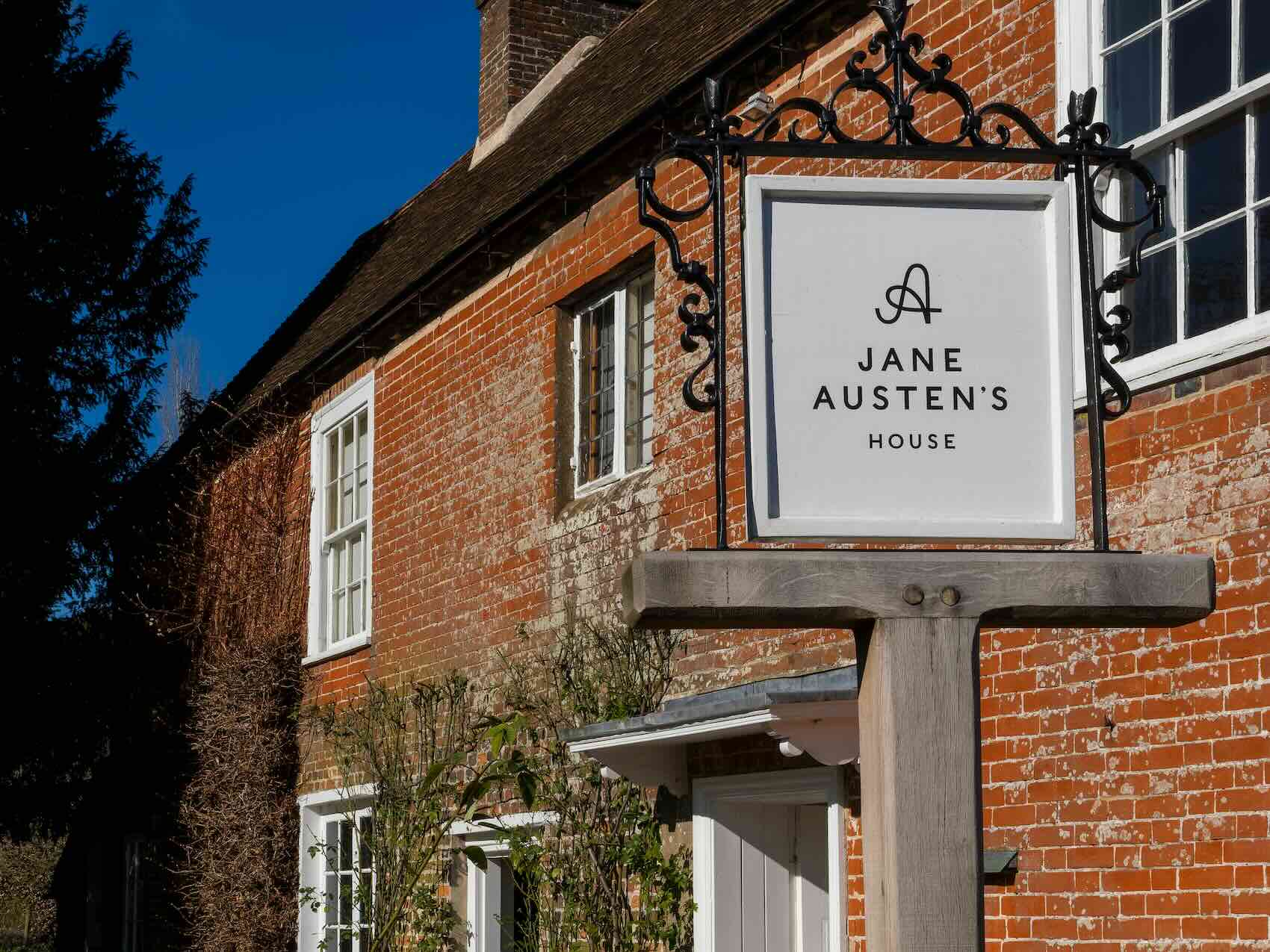
If you only visit one place on this list, make it Chawton. Austen lived in a small cottage in Chawton from 1809 until May 1817, when she left for Winchester, in a house her brother Edward offered to his mother and sisters. This is where she wrote Mansfield Park, Emma and Persuasion and revised Sense and Sensibility and Pride and Prejudice for publication.
A Jane Austen’s House tour takes in the Drawing Room where she practised the piano every morning, the Dining Room where she wrote at a tiny writing table, a bedroom the museum believes she shared with her sister Cassandra and the cottage garden. The museum also keeps a letter and a first edition on display.
The rooms are small and the doorways low, so only 12 visitors are let in every 20 minutes and tickets must be pre-booked, even for annual pass holders. In 2026 an adult ticket costs £15.50 at the door (£1 less online) and works as an annual pass. Opening days also shrink outside summer. At the time of writing (October 2026), their website says opening times are Wednesday to Sunday 10am-4pm. The upstairs is reached by a historic wooden staircase, so check the accessibility notes if you require it.
There’s plenty more to do within walking distance:
- Chawton House: Edward’s Great House, now a research library for early women’s writing, with gardens and a tearoom. It is run separately from Jane Austen’s House and needs its own ticket.
- St Nicholas Church: the graves of her mother and Cassandra are round the back of the church, which was rebuilt after a fire in 1871.
- The Jane Austen circular walk: a route of about 4½ miles through the countryside around Chawton, starting near the car park opposite the house and taking around 2¾ hours.
- Alton: a market town with a Jane Austen trail and the station you’ll arrive at.
Alton hosts Jane Austen Regency Week in June, a ten-day festival of talks, walks, music and a Regency ball. In 2026 it ran from 19 to 28 June, so expect something similar next year.
How to get there: Direct trains run from London Waterloo to Alton about every 30 minutes, and the fastest take just over an hour. Chawton is around 1½ miles from the station, which is a brisk 30-minute walk or about 8 minutes by taxi (roughly £10). The house says there’s no taxi rank at the station and Uber isn’t available, so pre-book a taxi (Wilson Taxis is based at the station), although a couple of local sites mention a rank.
By bus, the 38 drops you at Jane Austen’s House but runs infrequently. The 64 runs every 30 minutes but doesn’t stop in Chawton: get off at Lincoln Green and walk about 15 minutes and don’t get off at Chawton Roundabout because crossing the dual carriageway isn’t safe. By car, the house is just off the A31 (postcode GU34 1SD). The car park opposite started charging from September 2026 and there’s a free car park at the end of Gosport Road.
Winchester: Jane Austen’s Burial Site and the House Where She Died
Austen moved to Winchester in May 1817 for medical treatment and died at 8 College Street on 18 July that year, aged 41. The house is a private home, so you can only admire it from the street, but you can visit her burial site in Winchester Cathedral.
She’s buried in the north aisle of the nave. Look for her gravestone, the brass memorial plaque and the memorial window nearby.
Winchester is also a lovely city in its own right, with a medieval cathedral, a river walk and good pubs. It makes the best base for Chawton, which is about 30 minutes away by car or bus. I have a guide to Winchester here if you’d like to know more about it (where to eat, where to stay, what to do).
How to get there: Trains run from London Waterloo in around an hour. The cathedral is a 10 to 15 minute walk from the station.
WINCHESTER, ENGLAND’S ANCIENT CAPITAL: 10 Best Things to Do in Winchester, England
Southampton: Where She Lived From 1806 to 1809
After her father died, Austen, her mother, her sister Cassandra and their friend Martha Lloyd lived in Southampton until 1809, in a house in Castle Square shared with her brother Frank and his wife Mary. That house is gone (a pub stands on the site today) and parts of the city were destroyed in air raids in 1940, so this is a stop for Austen completists.
What’s left is a Jane Austen heritage trail past the medieval town walls, the medieval houses on Bugle Street and the Dolphin Hotel, whose first-floor ballroom is named after her.
How to get there: Southampton Central has direct trains from London Waterloo and the fastest take around 1 hour 15 minutes. It’s also a short hop from Winchester, with direct trains taking about 15 minutes.
Bath: Jane Austen Centre, the Pump Room and Gravel Walk
Bath is where Austen lived from 1801 to 1806 and set both Northanger Abbey and Persuasion. It’s also a very good city for a Jane Austen walking tour. Highlights include:
- The Jane Austen Centre: an exhibition on her time in Bath, with the Regency Tea Rooms on the top floor. You can book your entry ticket here.
- The Pump Room and Assembly Rooms: the fashionable gathering places of Austen’s Bath. You can have breakfast, lunch or afternoon tea in the Pump Room today.
- Milsom Street: heavily featured in her novels, with buildings that partly date from her time.
- Gravel Walk: the setting for Anne Elliot and Captain Wentworth’s love scene in Persuasion and a filming location for the 2022 Netflix adaptation. The Royal Crescent also features in that film.
- Sydney Gardens and 4 Sydney Place: her longest stay in Bath, three years at number 4, which is now a hotel with a plaque. Sydney Gardens sit opposite and has a Jane Austen trail.
- Beechen Cliff (now Alexandra Park): mentioned in Northanger Abbey and said to be one of her favourite viewpoints.
The Jane Austen Festival takes place every September, opening with the Grand Regency Costumed Promenade. I talk more about it further down this post. You can also book a Jane Austen and Bath history tour.
Where to stay: Search Booking.com for central Bath.
How to get there: Direct trains from London Paddington to Bath Spa take from around 1 hour 15 minutes at the fastest. Bath is compact and most sites are within walking distance of the station.
DISCOVER BATH: Essential Bath City Guide
Lyme Regis, Dorset: The Cobb From Persuasion
Austen visited Lyme Regis in 1803 and 1804 and it appears in Persuasion as the seaside town where Louisa Musgrove falls from the Cobb, the curved stone harbour wall, and suffers a concussion while Captain Wentworth helps her down the steps. Those steps are known locally as Granny’s Teeth, and you can still walk the Cobb today.
The 1995 and 2007 Persuasion adaptations were both filmed here and Lyme Regis is also a fossil-hunting town on the Jurassic Coast. Allow half a day to walk the Cobb and the town.
How to get there: There’s no station in Lyme Regis. The nearest is Axminster, about six miles away, with the X51 and X53 buses running to the town centre. Driving is easier.
Godmersham Park and Goodnestone, Kent: Edward’s Kent Estates
Jane’s brother Edward was adopted by the Knight family and inherited the Chawton estate and he also lived at Godmersham Park in Kent, which Jane and Cassandra visited often. Edward’s wife Elizabeth Bridges came from nearby Goodnestone Park and Edward and Elizabeth first lived at Rowling, about a mile away. Jane visited and danced at Goodnestone.
This is a niche stop for dedicated fans and access is limited. Godmersham Park’s house is closed to the public, but a public footpath crosses part of the estate with views of the house and a folly. The separate Godmersham Park Heritage Centre has been open on Mondays from April to October, 2pm to 4pm, depending on staff availability. Goodnestone’s gardens have opened on only a handful of National Garden Scheme days and the park is also a wedding venue, so check their website first. Goodnestone’s church is generally open during daylight hours. A car is the realistic way to see both.
Stoneleigh Abbey, Warwickshire: Jane Austen’s Leigh Family Home
After her father died in 1805, Jane, Cassandra and their mother left Bath and visited relatives, including the Leigh family at Stoneleigh Abbey in 1806, where Jane stayed for about ten days. The Abbey is said to have inspired Sotherton Court in Mansfield Park, the grand estate where the characters tour the house and gardens. The link is the landscaping, as Austen wrote about Humphry Repton working on the grounds of the fictional Sotherton and Repton had changed Stoneleigh’s grounds.
It’s open to visitors, but only on set days. At the time of writing the grounds were open Sunday to Thursday and the house could only be seen on a one-hour guided tour, with a specialist Jane Austen tour on Wednesdays at 2pm. Grounds entry was £8 for adults and £16 with a tour. The Abbey is closed on Fridays and Saturdays for private events.
How to get there: The Abbey is just off the A46 near Kenilworth. By public transport it’s a little tricky. A train to Coventry, bus X17 to Warwick (get off in
Rawnsley Drive and walk 29min).
Brighton: Lydia, Wickham and the Royal Pavilion
Austen probably did visit Brighton, but there’s no documentary proof, according to Brighton & Hove Museums, so this one is mostly a literary link. In Pride and Prejudice, Mrs Bennet and Lydia both cry “If one could but go to Brighton!” because of the “campful of soldiers” stationed there and Lydia’s trip to the town ends in her elopement with Wickham. The resort was also a favourite of the Prince Regent, who had the Royal Pavilion built as a seaside retreat before commissioning John Nash to rebuild it from 1815. Austen was one of George IV’s favourite writers.
If you want a Jane Austen Brighton stop, visit the Royal Pavilion for a look at the Regency world she lived in and walk along the seafront. It’s a good half-day if you’re in the area, and the Pavilion is less than a 10-minute walk from the station.
How to get there: Direct trains run from London Victoria (Southern) and some Thameslink stations and the fastest take around an hour.
Jane Austen Filming Locations: Where to Find Pemberley and Meryton
You don’t have to be a Pride and Prejudice completist to enjoy these, but it helps. Most are run by the National Trust, although Chatsworth is not.
12. Lacock, Wiltshire: Meryton in the 1995 BBC Pride and Prejudice
Lacock is a National Trust village that stood in for Meryton in the 1995 BBC adaptation of Pride and Prejudice, with the Red Lion pub used for the exterior of the Meryton assembly rooms. The village also has Lacock Abbey and the Fox Talbot Museum, which are covered by the same ticket and the National Trust suggests about three hours for a visit.
How to get there: The nearest station is Chippenham, and the number 234 bus to Frome stops in Lacock. By car, Lacock is about 2 miles south of Chippenham off the A350.
Lyme Park, Cheshire: Pemberley and Darcy’s Famous Dip
Lyme Park was Pemberley’s exterior and grounds in the 1995 BBC series, including the lake scene where Colin Firth emerged in a wet shirt, a scene that wasn’t in the book. The Pemberley interiors were filmed at Sudbury Hall in Derbyshire, so you won’t see those rooms here, but the Regency mansion and the park are worth the trip on their own. It’s a National Trust site on the edge of the Peak District.
How to get there: Disley is the nearest station, about 0.5 miles (a 20-minute walk) to the park entrance and roughly another mile to the house. A volunteer-run shuttle bus runs on most days but isn’t guaranteed and if you arrive by train or bus the National Trust offers free park and garden entry with a same-day ticket. The 199 Skyline bus also stops nearby. Pair it with Chatsworth for a northern film location trip.
Chatsworth, Derbyshire: Pemberley in the 2005 Film
Chatsworth stood in for Pemberley in the 2005 film with Keira Knightley and Matthew Macfadyen. It’s also named in the novel itself: Mrs Gardiner’s plans for the Derbyshire tour include Matlock, Chatsworth, Dovedale and the Peak. Many people believe Austen had Chatsworth in mind for Pemberley, though that’s an unproven theory. The house is enormous and the gardens are even better, with a landscape shaped by Capability Brown from the 1750s.
How to get there: Chatsworth has no train station. Chesterfield is the closest major station and the 170 bus runs from there to Chatsworth, while Matlock is the nearest station but its 160 bus doesn’t run at weekends. Driving is easiest.
Basildon Park, Berkshire: Netherfield in the 2005 Film
Basildon Park, a National Trust Palladian-style mansion in Berkshire, played Netherfield, Mr Bingley’s house, in the 2005 film.
How to get there: The nearest stations are Pangbourne (about 2½ miles) and Goring and Streatley (about 3 miles). Neither has a taxi rank, so pre-book a taxi, and the National Trust advises against walking along the busy main road. Most people will find a car easier.
More Jane Austen Filming Locations Worth Knowing About
If you want to go further, these places appear in Austen adaptations. Check opening times for each before you go.
- Belton House, Lincolnshire: Lady Catherine de Bourgh’s Rosings Park in the 1995 series.
- Sudbury Hall, Derbyshire: the interiors of Pemberley in the 1995 series.
- Haddon Hall, Derbyshire: the inn at Lambton in the 2005 film.
- Stourhead, Wiltshire: the Temple of Apollo, used for Darcy’s first, rain-soaked proposal in the 2005 film.
- Burghley House, Lincolnshire: Rosings Park in the 2005 film, with its Heaven Room as Lady Catherine’s drawing room.
- Montacute House, Somerset: the Palmers’ country home in the 1995 Sense and Sensibility.
- Saltram, Devon: Norland Park in the 1995 Sense and Sensibility.
- Wilton House, Wiltshire: a location in the 1995 Sense and Sensibility.
- Ham House, London: a location in the 2008 Sense and Sensibility.
Jane Austen Balls and Festivals
If you’d like to dress up and dance, these are the two big events:
- The Jane Austen Festival, Bath (September): ten days of walks, talks, workshops and dance classes, opening with the Grand Regency Costumed Promenade, when hundreds of people in Regency dress walk through the streets. In 2026 it ran from 11 to 20 September and the ball events sold out, with even the waiting lists full, so book early for next year. Regency dress is only required for the Promenade and the evening balls.
- Jane Austen Regency Week, Alton and Chawton (June): ten days of Regency-style music, dining, drama, talks and guided walks that finish with a Regency Ball. In 2026 it ran from 19 to 28 June.
If you’d like a Regency feel without the full costume, many of the events in both festivals are walks, talks and concerts you can just turn up to.
Where to Stay on a Jane Austen Tour of England
Search Booking.com for:
- Winchester: the best base for Chawton, the cathedral and Steventon.
- Bath: best for the Georgian centre, the Jane Austen Centre and the September festival. Book early for festival weekends.
- London: best for the writing desk and the Austen addresses. See my London Neighbouhood Guide + Hotel Recs.
What to Pack for a Jane Austen Tour of England
Comfortable walking shoes are essential: Chawton, Box Hill, Lyme Regis and the grounds at Lyme Park and Chatsworth all involve a lot of walking, often on uneven ground. Add a waterproof jacket and a compact umbrella, because England. If you’re planning to read her novels on the trains, a paperback is easier to carry than a hardback. Personally, I LOVE audiobooks so I can listen on my walks, doing chores or anytime I want to switch off whatever’s going on in my head.
Final Thoughts: Which Jane Austen Places Are Worth It?
If you only have a few days, go to Chawton, Winchester Cathedral and Bath. Between them they cover where she wrote, where she died and where she set two of her novels. Add Lacock or Lyme Park if you’re more of a Pride and Prejudice fan than an Austen biography fan.
The more obscure stops, like Godmersham and Stoneleigh Abbey, are for people who already know the answer to “Mansfield Park or Emma?”. Southampton and Brighton are optional extras. London and Box Hill are the easiest to fit around a normal city break.
FAQ: Jane Austen Tour of England
She lived in Steventon, Hampshire (1775 to 1801), Bath (1801 to 1806), Southampton (1806 to 1809) and Chawton, Hampshire (1809 to 1817). She died in Winchester in 1817.
Winchester Cathedral. Her grave is in the north aisle of the nave, and you’ll find her gravestone, a memorial brass and a memorial window nearby.
Yes. Jane Austen’s House in Chawton, near Alton, is open to visitors with timed tickets and it’s best to pre-book.
Sadly, no, but I gave you a tour idea of an easy, self-guided Jane Austen tour from London at the beginning of the post (Chawton/Alton + Winchester).
Mostly. London, Winchester, Alton (for Chawton), Southampton, Bath and Brighton all have direct trains from London, but Steventon, Lacock, Lyme Regis and most filming locations need a car, taxi or bus.
Three days covers London, Chawton and Winchester. Five to seven days lets you add Bath, Lyme Regis and a film location or two.
In the 1995 BBC series, Lyme Park was Pemberley’s exterior, Lacock was Meryton and Belton House was Rosings. In the 2005 film, Chatsworth was Pemberley and Basildon Park was Netherfield.
Lyme Regis and Bath both feature in screen adaptations of Persuasion, including the 1995 and 2007 versions and the Netflix film, which used Gravel Walk in Bath.
The Jane Austen Festival in Bath in September and Jane Austen Regency Week in Alton in June both include Regency balls. Tickets can sell out, so book early.
June and September if you want festivals, or spring and early autumn for walking and gardens. Many houses have reduced opening days in winter.
Resources for Your Jane Austen Tour of England
- Hotels: Booking.com
- Tours and day trips: GetYourGuide and Viator
- Trains: Omio
Enjoyed this? You might also like: