This post contains affiliate links, meaning I may earn a small commission if you make a purchase through them at no extra cost to you. Using these links helps keep this blog running, so I truly appreciate it if you choose to do so. Thank you for your support!
London is one of the cities that just give literary vibes. Whether it’s the plethora of bookshops around the city, the blue plaques on quiet residential streets with names many people will recognise, pubs and other sceneries that inspired classics. Some of it takes a bit a bit of digging to find. I’ve spent years wandering into these spots without really planning to, so this is less a checklist and more a map of where London’s literary history actually sits, built from the places I’ve been to or added to my list but haven’t made to yet.
If you’re a book lover planning a London trip and want more than the Shakespeare’s Globe photo op, this one’s for you.

Quick Guide: Literary London
📍 Best base: Bloomsbury or Primrose Hill, both walkable to most of this list
🚗 Getting around: All on the Tube or on foot, no car needed
🗓️ Best time to visit: Year-round, though Highgate Cemetery and Kensington Gardens are especially good on a crisp autumn day
🏨 Where to stay: President Hotel (round the corner from the outstanding Fortitude Bakehouse!)
🎟️ Don’t miss: Cecil Court’s bookshops, Highgate Cemetery, the Sherlock Holmes Museum
⚠️ Heads up: Several of these are residential streets with blue plaques rather than proper attractions, so keep it respectful of people’s actual homes
Bloomsbury and Virginia Woolf
Bloomsbury is where Virginia Woolf and the wider Bloomsbury Group lived, worked and argued about art for decades and it’s still one of the best parts of London to walk through with that history in mind (maybe because there are also some great bookshops around!). Gordon Square in particular was home to Woolf at various points, along with several other members of the group. Her specific blue plaque sits on Tavistock Square, a short walk away, marking a house she and Leonard lived in for over a decade.
If you want to take the Woolf connection further afield, there’s also a statue of her in Richmond, where she and her husband Leonard ran the Hogarth Press for several years. I’ve been and it’s a nice quieter add-on if you’re already heading that way.
Sylvia Plath and W.B. Yeats in Primrose Hill
Primrose Hill has two blue plaques worth knowing about and they’re connected in a way. Sylvia Plath lived at 3 Chalcot Square with Ted Hughes in the early 1960s and that’s where her own blue plaque is today, put up by her children in 2000.
A few streets away is 23 Fitzroy Road, where Plath moved after her marriage ended. The blue plaque on that building isn’t for Plath at all, though; it’s for W.B. Yeats, who lived there as a boy. Plath specifically sought out that flat because of the Yeats connection, seeing it as a sign of good fortune for her own writing. She died there a few weeks later. It’s a heavy piece of literary history to stand in front of.
Cecil Court: London’s Booksellers’ Row
Tucked just off Charing Cross Road, Cecil Court is a pedestrian alley lined with antiquarian and secondhand bookshops, earning it the nickname “Booksellers’ Row.” It’s been a hub for booksellers since the early 1900s and it’s said to have partly inspired Diagon Alley in the Harry Potter books, which tracks the moment you actually walk down it. Although a few different places have been said to have inspired Diagon Alley, including Victoria Street in Edinburgh.
One shop in particular is worth knowing about if witchy history is your thing (and if you’ve read anything else on this blog, it probably is): Watkins Books, London’s oldest esoteric and occult bookshop, has been trading from Cecil Court since 1901. I’ve got a whole guide to witchy shops in London if this is your kind of detour.
FOR WATKINS AND MORE: Witchy Shops in London
Cecil Court isn’t the only place with bookshops worth your time though. Hatchards on Piccadilly has been open since 1797, making it the oldest bookshop in Britain, holds three Royal Warrants and still keeps a staircase where Oscar Wilde once sat to sign copies of his own books. Foyles on Charing Cross Road is the other essential stop, a five-floor flagship with a literary events programme most weeks. I’ve got a full guide to London’s best bookshops if you want the complete list rather than just these two.
Sherlock Holmes Museum, Baker Street
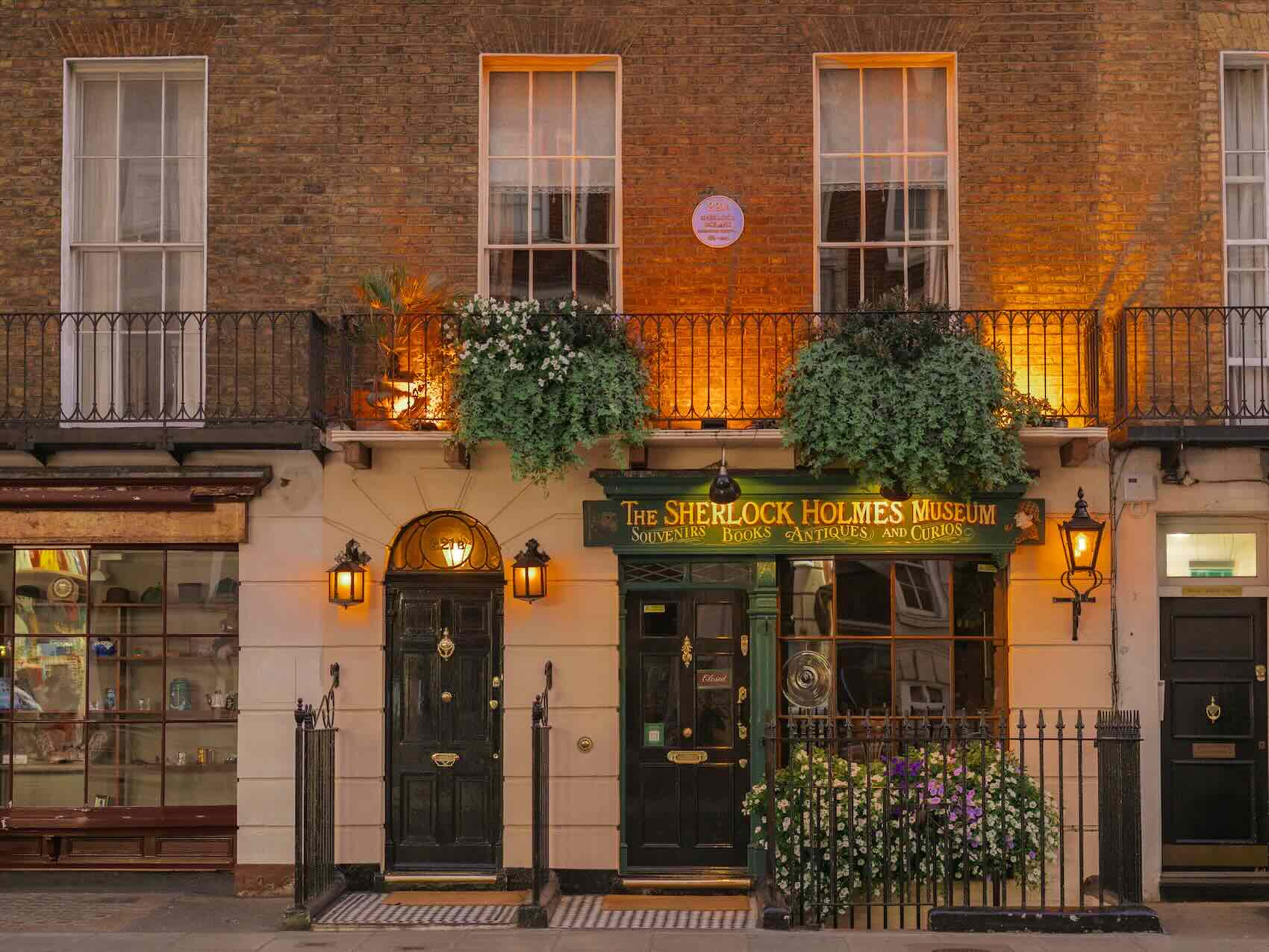
Not a real author’s home, but an old childhood obsession of mine, so it’s earning its spot. The Sherlock Holmes Museum at 221B Baker Street leans fully into the fiction, styled as Holmes and Watson’s actual Victorian flat and it’s a fun visit if you love the stories, the films or the games the way I do. I grew up playing the 221B Baker Street board game and love it to this day! I play with my niece and nephew now but, incredibly (and annoyingly), once I start a lot of the cases I end up remembering the answers from way back when.
The place can get busy, especially on weekends. Worth checking availability before you go.
You can also do a Sherlock Holmes walking tour! This tour in particular not only takes you to a bunch of Sherlock-related spots but the guide is also very knowledgeable when it comes to Sir Arthur Conan Doyle.
Charles Dickens Museum, Bloomsbury
48 Doughty Street is Dickens’s only surviving London home and it’s a proper museum experience rather than a plaque on a wall. He lived here just two years, from 1837 to 1839, but they were extraordinarily productive ones: he finished The Pickwick Papers, wrote Oliver Twist and Nicholas Nickleby start to finish and began Barnaby Rudge. The house is spread across four floors with over 100,000 items, including his original manuscripts and furniture and it’s an immersive way to picture how he actually lived and worked rather than just where.
Shakespeare’s Globe, Bankside
The current Globe is a faithful reconstruction, opened in 1997 about 230 metres from where Shakespeare’s original theatre stood before it was demolished in the 1640s. It’s the only building in central London permitted a thatched roof since the Great Fire banned them everywhere else, which gives you a sense of how seriously the reconstruction took getting the details right. Catching a play here, standing in the yard the way Elizabethan audiences did, is a truly different experience from reading the same lines in a book.
British Library Treasures Gallery
Free to enter and one of London’s most underrated stops for book lovers. The Sir John Ritblat Gallery holds Jane Austen’s actual travelling writing desk alongside handwritten pages from her novels, an early draft of Virginia Woolf’s Mrs Dalloway, a page of Jane Eyre in Charlotte Brontë’s own hand and the Beatles’ lyrics scrawled on the backs of birthday cards. It’s a strange and brilliant thing to stand in front of a writer’s actual handwriting rather than a printed page and it costs nothing to do it.
Highgate Cemetery
Highgate Cemetery is one of London’s most…hmmm… dark academia-esque?! spots regardless of the literary angle, but it’s also home to a truly eclectic mix of graves. Karl Marx’s grave is the famous one, an enormous monument that’s hard to miss. Not far from it is Douglas Adams, of The Hitchhiker’s Guide to the Galaxy, a much smaller and quieter grave by comparison but very cool adorned with pens and what not. George Eliot is also buried here, in the cemetery’s East side, alongside Marx.
Autumn in Highgate is absolute GORGEOUS! Flick through my photos of last year’s one here for a photo of the huge Karl Marx head:
Bunhill Fields, near Old Street
Less famous than Highgate, but a genuinely remarkable cluster of graves in a small space. William Blake, John Bunyan and Daniel Defoe are all buried here within a short walk of each other, alongside the hymn writer Isaac Watts. It’s free, it’s easy to combine with a visit to nearby Old Street and it’s the kind of quiet, slightly overlooked spot that fits the tone of this post.
Peter Pan Statue, Kensington Gardens
A small detour into children’s literature: the bronze Peter Pan statue in Kensington Gardens was commissioned by J.M. Barrie himself and has stood there since 1912. It’s an easy add-on if you’re already in the park and a nice one for anyone travelling with kids who grew up on the story.
Keats House, Hampstead
John Keats lived in this Hampstead house between 1818 and 1820 and it’s where he wrote Ode to a Nightingale. I’ve walked past it more times than I can count without going in, which is a bit ridiculous of me. I lived down the road for FIVE YEARS! Also missed the Freud Museum further up. 🤡
Poets’ Corner, Westminster Abbey
Inside Westminster Abbey, Poets’ Corner is where over a hundred poets and writers are buried or memorialised, a tradition that started almost by accident with Geoffrey Chaucer’s burial there in 1400, after which later admirers wanted to be laid to rest near him. Charles Dickens is buried here too, despite reportedly having wanted a quiet, private funeral elsewhere. Worth knowing before you go: several of the names here are memorials rather than graves, including Jane Austen (buried in Winchester Cathedral!) and the Brontë sisters, so you’re not wandering around looking for a burial spot that doesn’t exist.
Poets’ Corner is included in general Abbey admission rather than needing a separate ticket, but the Abbey gets busy, especially in peak season, so booking ahead through GetYourGuide is worth it if you’ve got a specific day in mind. You can also get this skip-the-line ticket + guided tour for a bit of a higher price.
LONDON FOR BOOK LOVERS: Best Bookshops in London
Literary Pubs and Clubs
Ye Olde Cheshire Cheese on Fleet Street is the heavyweight of the group. Rebuilt in 1667 after the Great Fire, it’s been pulling in writers for over 350 years: Dickens drank here and wrote it into A Tale of Two Cities, while Mark Twain, Conan Doyle and Yeats were all regulars too. In 1890, Yeats and Ernest Rhys founded the Rhymers’ Club here, a loose group of poets who met to eat, drink and read their verse aloud to each other, which is about as literary as a pub gets.
Fitzrovia takes its name from the Fitzroy Tavern, a Victorian pub that became the epicentre of London’s literary bohemia in the early 20th century. Dylan Thomas and George Orwell both drank here and the walls are still lined with portraits of the regulars who did.
Over in Southwark, the George Inn is London’s last surviving galleried coaching inn, now owned by the National Trust. Dickens was a genuine regular and mentions it in Little Dorrit, and its courtyard is the sort of place that would have hosted Elizabethan inn-yard theatre, close enough to the Globe that a Shakespeare connection is plausible even if it’s not fully proven, which is usually how these stories get told anyway.
Dr Johnson’s House, Gough Square
A short walk from Ye Olde Cheshire Cheese, which makes it an easy pairing if you’re already doing the Fleet Street pub stop. Samuel Johnson lived here from 1748 to 1759 and it’s in the attic of this house that he compiled his Dictionary of the English Language, one of the most significant works in the history of the English language, written by a handful of assistants working out of what was essentially a converted counting house.
More Literary Women Worth Knowing About
Agatha Christie has a blue plaque at 58 Sheffield Terrace, Kensington. Her real pilgrimage site is in Devon though. Greenway House, her National Trust-run holiday home near Torquay and the Agatha Christie Gallery at Torquay Museum, the only permanent exhibition dedicated to her in the UK.
Mary Shelley is connected to both a blue plaque at 24 Chester Square, Belgravia and St Pancras Old Church, where she’s said to have grown close to Percy Shelley at her mother’s grave. Frankenstein’s idea came from a rain-soaked summer at Villa Diodati on Lake Geneva in 1816, when Byron challenged Mary, Percy and their friends to each write a ghost story, but the novel itself was mostly written afterwards in Bath, where a plaque near the Roman Baths marks the spot and Mary Shelley’s House of Frankenstein now runs an immersive exhibit on the story.
George Eliot has a blue plaque on Cheyne Walk in Chelsea.
Beatrix Potter’s childhood home is marked with a blue plaque at Bolton Gardens, Kensington but the deeper connection is Camfield Place near Hatfield in Hertfordshire, her grandparents’ house, which she called “the place I love best in the world” and which likely inspired parts of The Tale of Peter Rabbit. It’s open for guided tours today.
Final Thoughts
London doesn’t hand you its literary history on a plate. There’s no single walking tour that covers all of it, and half of what’s actually worth seeing is a blue plaque on an ordinary street that most people walk straight past. That’s sort of the point though. Standing outside 3 Chalcot Square doesn’t feel the same as reading about Plath in a textbook, and neither does looking up at a small door in Highgate that leads to Douglas Adams’s grave.
This list is a mix of places I’ve properly stood in front of and ones still sitting on my own to-do list, which feels right for a post about literary London. It’s not a finished project, and I don’t think it’s meant to be. If Keats House or Poets’ Corner end up being your next stop rather than mine, that’s the whole point of a map instead of a checklist — work through it in whatever order suits your trip, and don’t feel like you need to tick off every single one.
If you’ve only got a day, I’d pair Bloomsbury with Cecil Court and call it done. With longer, spread it out and do Highgate/Hampstead on one day and Kensington Gardens/Hyde Park and even stretch to Baker Street on another.
FAQ: Literary London
Bloomsbury and Primrose Hill both work well as self-guided literary walks, covering Virginia Woolf, Sylvia Plath and W.B. Yeats within a fairly compact area.
Yes, especially if you like secondhand and antiquarian books. It’s a small, easy add-on near Leicester Square rather than requiring a dedicated trip.
She lived at 3 Chalcot Square, Primrose Hill, with Ted Hughes in the early 1960s, and later at 23 Fitzroy Road, a few streets away, where a blue plaque actually commemorates the building’s earlier resident, W.B. Yeats.
If you’re a fan of the stories, yes. It’s small but full of character, styled as Holmes and Watson’s Victorian flat. It’s a bit of a tourist trap BUT it’s also pretty sweet. I enjoyed it!
Enjoyed this? You might also like: