This is a post about witchy places to visit in the UK.
This post contains affiliate links, meaning I may earn a small commission if you make a purchase through them at no extra cost to you. This website is reader-supported and by using these links you help support my work and I truly appreciate it. Thank you for your support!
As a child of the 80s, early teen in the 90s, I’m part of that group of women introduced to the witchy world via the likes of Charmed, The Craft and Sabrina Teenage Witch. More recently, especially living in the UK, I’ve become more interested in the subject matter and I love a witchy vibe, a crystal shop… and I’ve noticed a lot of you do too because my witchy shops in London post has been in my top 5 most read for MONTHS. So I thought I should write more about it. You know, give the people what they want!
Starting with witchy places. In the case of this post, witchy places to visit in the UK. I LOVE a witchy town, a witchy shop… The UK is full of these places! This is a country that executed thousands of people for witchcraft, built stone circles that predate Stonehenge by millennia and has a village where a self-proclaimed witch used to walk the streets with a jackdaw on her shoulder. The witchy and mystical side of Britain isn’t a niche interest, it’s baked into the landscape.
I’ve been collecting these places for years! In this guide I’m sharing the most magical and witchy places to visit in the UK. Some you’ll know, some most people drive straight past.

Quick Guide: Witchy Places in the UK
| Best base | London (central for Somerset, New Forest, Edinburgh by train) |
| Getting around | Mix of train and car; Pendle Hill and Avebury really need wheels |
| Best time to visit | Year-round; October and May have the best vibe |
| Easiest from London | Edinburgh (direct train), Whitby (train via York) |
| Most underrated | Pendle Hill, Lancashire; extraordinary history, almost no crowds |
| Witchiest place overall | Glastonbury, Somerset |
| Don’t miss | The Witches’ Well at Edinburgh Castle; small, free and very easy to miss among the crowds |
| Book accommodation | Booking.com |
Glastonbury, Somerset
If there’s one place in England that earns the word “witchy” without any caveats, it’s Glastonbury.
The town is essentially one long act of devotion to the mystical. Walking the High Street, you pass:
- Star Child: hand-blended incenses and ritual oils made here since 1990;
- Cat and Cauldron: spell candles, antique tarot decks, the works; and
- a rotating cast of crystal shops, herbalists and tarot readers.
The whole street smells faintly of sage and something you can’t quite identify.
But the landscape around Glastonbury is what makes it genuinely extraordinary. The Tor, a steep hill rising out of the Somerset Levels with a ruined medieval tower at its summit, is unlike anything else in England. On a misty morning it floats above the fog like it doesn’t belong in this century. The walk up takes about 20 minutes from the town centre, it’s free and if you can manage sunrise up there you’ll be talking about it for years.
The Chalice Well Gardens, a five-minute walk from the Tor, are worth a separate visit. This natural spring has flowed continuously for over two thousand years. The iron-rich water leaves a rust-red stain on everything it touches and the gardens are one of the most genuinely peaceful places I’ve sat in England. Small entry fee, open year-round.
One thing most visitors miss: the White Spring, directly across the road from the Chalice Well entrance. It’s a completely different spring, housed in an old Victorian reservoir that’s been turned into a candlelit shrine. Free to enter and almost always overlooked.
Getting there
No train station in Glastonbury; closest is Castle Cary (trains from London Paddington, just under 2 hours), then a bus or taxi. A car is easier if you’re combining with Avebury.
Burley Witch Village, New Forest
Burley is a small New Forest village that has completely, cheerfully earned its reputation as England’s witchiest village. I finally paid it a visit a few months ago and LOVED IT! Paired with a gorgeous hike around New Forest.
Anyway, the witchy rep comes down to one woman: Sybil Leek, a self-proclaimed white witch* who moved there in the 1950s and became one of the most famous witches in England. She walked the village in a long black cloak with her pet jackdaw, Mr Hotfoot Jackson, on her shoulder, appeared on television, wrote dozens of books on the occult and astrology. Before local pressure forced her to the US, she named the village’s main occult shop A Coven of Witches. Established in 1955, it was the first Wiccan shop in Britain.
That shop is still there. Sybil’s portrait hangs above the Jacobean fireplace. It stocks crystals, tarot decks, incense, ritual items and altar goods and offers tarot readings and Reiki sessions throughout the year. The Horsa Coven she founded in the New Forest still quietly exists today.
What makes Burley feel genuinely witchy rather than just touristy is the forest itself. The New Forest is ancient, strange and just has that magical, mystical vibe. There’s also The Sorcerer’s Apprentice gift shop and Cobwebs & Crystals nearby, so you can spend a very enjoyable afternoon moving between shops and woodland without it ever feeling like a theme park.
I have to also recommend the coffee shop Noohn. It was hard to choose just one cake – everything was so delicious! The caf is small and gorgeous and the staff super friendly. They had beautiful half moon biscuits and moon mugs for sale.
Go on a weekday if you can, weekends in summer get busy with families, which is lovely but slightly breaks the spell.
Getting there
Best by car; about 1.5 hours from London. Closest train station is Brockenhurst, about 6 miles away (a great town to visit for a hike! I’ll do a separate post about it soon)
*I REALLY dislike the terms “white witch” and “black magic”…but it’s here as that’s how she identified.
YOU MIGHT ALSO LIKE: Burley Witch Village: Discover England’s Most Bewitching Hidden Gem
Pendle Hill, Lancashire
Pendle Hill is where this kind of travel gets very real very fast.
In 1612, twelve people from the villages around this Lancashire moorland hill were accused of witchcraft. Ten were hanged at Lancaster Castle on 20 August 1612. It became one of the most thoroughly documented witch trials in English history; England’s answer to Salem is not an exaggeration.
The story started when Alizon Device, a teenager from a local family, allegedly cursed a passing pedlar who then collapsed on the road. What followed involved two rival families, a magistrate with political motivations, a nine-year-old girl (Jennet Device) testifying against her own mother and brother and King James I who had personally written a treatise on witchcraft. The accused weren’t mysterious outsiders, they were village healers, people who made a living from herbal remedies and folk magic in a part of Lancashire devastated since Henry VIII dissolved the local abbey.
The hill itself is a long, bleak moorland ridge rising to 557 metres. The main trail starts at the village of Barley, about 8km return, steep in places, with views across the Yorkshire Dales, the Lake District and the Lancashire coast from the top. On a grey day with low cloud, it feels genuinely haunted.
The surrounding villages tell the story through plaques and statues: Alice Nutter, the most unusual of the accused, a wealthy landowner rather than a peasant, has a life-size statue in Roughlee. The Pendle Heritage Centre in Barrowford has a dedicated exhibition and is a good starting point.
Getting There
Check Omio for train options to Burnley, then a car or taxi from there.
ICYMI: The Pendle Hill Witches: History, the Trail and How to Walk It Yourself
Edinburgh, Scotland
Edinburgh earns its place on any witchy UK list on numbers alone.
Between the 16th and 18th centuries, Scotland executed between 3,000 and 4,000 people under its Witchcraft Acts. Around three times as many per capita as England and four times the European average. More people were burned at the stake on Edinburgh Castle’s esplanade than anywhere else in Scotland.
The king driving much of this was James VI of Scotland (later James I of England). He became convinced that witches were trying to kill him after his ship was battered by storms crossing from Copenhagen. He personally oversaw witch trials and torture from Edinburgh Castle itself.
The Witches’ Well on the castle esplanade is the memorial to all of this. It’s a small cast-iron fountain easy to miss if you’re focused on the castle entrance ahead (look for it low on the wall of what’s now the Tartan Weaving Mill). A bronze relief of two faces intertwined with a serpent and foxglove, commissioned in 1894, marked with the dates 1479 and 1722, the span of the Scottish witch hunt. Over 300 people were strangled or burned on the ground you’re standing on. It’s free, it takes about 30 seconds to find and it genuinely stops you in your tracks.
Beyond the Well, Edinburgh’s ghost and witch tour industry is one of the more genuine in the UK. The underground vaults, the Old Town closes, the volcanic rock the city sits on; the geography and history reinforce each other here better than almost anywhere else in Britain. I’ve recently written a post exclusively about witchy sights in Edinburgh if you want to get more into it.
You can also join a Witch & Haunted History Tours!
Getting there
Direct trains from London King’s Cross take about 4.5 hours.
READ MORE: Best of Witchy Edinburgh: Magical Places, Shops and Hidden Gems
Avebury, Wiltshire
Stonehenge gets all the press but Avebury is actually older.
You can walk among the stones here and actually touch them, something you can’t do at Stonehenge. And the scale of it is almost impossible to comprehend until you’re standing inside: this is the largest stone circle in the world, so large that an entire village was built inside it over the centuries. The stones form a ring around houses, a pub (the Red Lion, technically within the circle) and a church.
The complex dates to around 2600 BCE and includes the main circle, two smaller inner circles and a processional avenue of standing stones called West Kennet Avenue that once stretched for over a mile. Nobody knows exactly what it was for. You can park in the village, walk into the stones without buying a ticket and spend a couple of hours just wandering. Try doing that at Stonehenge!
Combine it with West Kennet Long Barrow, a Neolithic burial chamber you can actually walk inside, completely free, barely signed and usually almost empty, and Silbury Hill, the largest man-made prehistoric mound in Europe, a 10-minute drive away. West Kennet is one of the more extraordinary things of its kind in England. You duck through a low stone entrance and you’re inside a 5,500-year-old tomb.
Getting there
About 20 minutes by car from Swindon. Closest train stations are Pewsey or Swindon. I’d highly recommend a car for the wider area.
Whitby, North Yorkshire
Whitby earns its place through pure, concentrated gothic atmosphere.
The ruined 13th-century abbey perched on the clifftop above the harbour, the 199 steps leading up from the old town, the narrow streets of fishermen’s cottages below; all of it fed directly into Bram Stoker’s imagination when he stayed here in 1890 and wrote the chapters of Dracula set in England. His Count Dracula arrives in Whitby as a large black dog bounding ashore from a shipwreck. You can see exactly why when you stand on that clifftop.
Whitby hosts two large Goth Weekends a year: April and late October. The whole town transforms into something extraordinary. But even on an ordinary Tuesday in February, it works. The old town on the east cliff has independent bookshops, jewellers selling Whitby jet (a black gemstone made from fossilised wood, traditionally associated with mourning and protection) and fish and chips that are genuinely among the best in England.
English Heritage manages the abbey (small entry fee). St Mary’s churchyard beside it is free, worth a slow wander and has views back over the harbour that are among the best in Yorkshire.
Getting there
Trains run from York to Whitby in about 1.5 hours. York is 2 hours from London King’s Cross if you want to combine both into a weekend. Book accommodation ahead around Goth Weekends.
Cornwall
Cornwall has its own ecosystem of folk magic and pagan practice that predates the modern New Age movement by centuries. I’ve written a whole dedicated post about the witchy side of Cornwall here, so I won’t duplicate it all but this gorgeous county absolutely belongs on this list.
The Merry Maidens stone circle near Penzance is one of the best-preserved Neolithic stone circles in England, a perfect ring of 19 granite standing stones in an open field, free to visit and almost always quiet. The legend is that the stones are young women turned to stone for the sin of dancing on the Sabbath. It says something interesting about how much medieval Christianity feared women enjoying themselves!
The wider landscape of west Cornwall like the moorland, the sea stacks, the ancient fogous (underground stone chambers with no certain purpose) has a quality that feels genuinely different from the rest of England. The full Cornwall post covers specific spots, walks and places to stay.
Getting there
Cornwall is VERY tricky without a car. You can take a train to some of the bigger towns but to really get around you need a car, especially to visit these magical sights!
READ MORE: 13 Most Magical Places to Visit in Cornwall This Year
Pentre Ifan, Pembrokeshire
Wales is threaded through with folklore about witches (gwrach in Welsh), sprites and the spirit world and the Preseli Hills in Pembrokeshire are where this feels most tangible.
Pentre Ifan is a Neolithic burial chamber dating back 5,500 years, with a massive capstone balanced on three standing stones in a way that seems structurally impossible. It sits in open farmland in the Pembrokeshire Coast National Park with views over the hills that stretch to the sea on a clear day. It’s free, there are no crowds and you can walk right up to the stones. The Preseli Hills above it are where the bluestones of Stonehenge came from; they were transported almost 200 miles to Wiltshire, which nobody has ever fully explained.
The wider Pembrokeshire landscape is dotted with other Neolithic sites, holy wells and places thick with the older Welsh supernatural tradition. St Non’s Well near St Davids, said to have miraculous healing properties and built on the birthplace of Wales’s patron saint, has been a site of pilgrimage for over a thousand years. The combination of ancient history, dramatic coastline and genuine sense of remoteness makes this part of Wales feel as charged as anywhere in the UK.
Getting there
Best by car; the closest train station is Haverfordwest (trains from Cardiff). A car is essential for exploring the wider area.
The Dark Hedges, Northern Ireland
Yes, you’ve seen it on Game of Thrones. Yes, it’s even more eerie in real life but only if you know when to go.
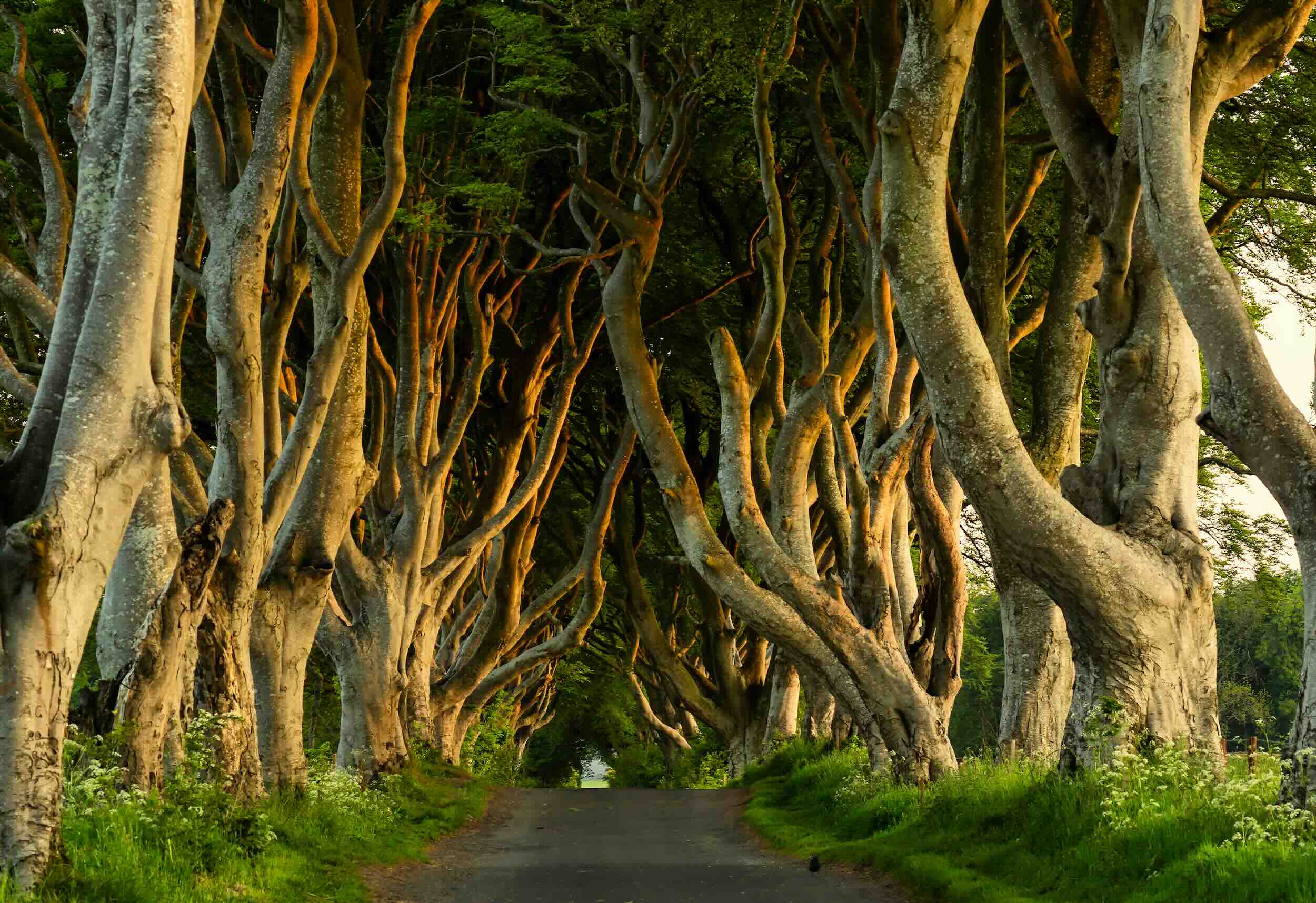
The Dark Hedges were planted in the 18th century by James Stuart to create an impressive approach to his Georgian mansion, Gracehill House. Two centuries later the twisted beech branches have grown into a tunnel overhead that looks like it was designed by someone who’d read too much gothic fiction. It became the King’s Road in Game of Thrones Season 2 and that’s when the whole world found out it existed.
But the story that matters for this list predates HBO entirely. Local folklore tells of the Grey Lady, a ghost said to wander the avenue and flit between the trees. Some believe she’s the restless spirit of a maid from the nearby house who died under mysterious circumstances; others say she’s the daughter of James Stuart himself. A third version holds that she’s a wandering soul from an old forgotten graveyard hidden beneath the surrounding fields and that on Halloween night those graves open and she is joined on her walk by the other spirits buried there.
A word of genuine honesty: the Dark Hedges look more dramatic in photographs than in person, partly because over-tourism has damaged the trees and the avenue is more spread out than any Instagram post suggests. Go at sunrise on a weekday, outside summer if possible. That’s when the Grey Lady version is what you actually see.
Getting there
On Bregagh Road near Armoy in County Antrim, about an hour from Belfast by car. Road access is restricted. Park at the Hedges Hotel and walk the short distance. Alternatively, Viator has tours from Belfast that combine the Dark Hedges with the Giant’s Causeway if you want to cover both in a day.
Are Glastonbury and Avebury Worth Visiting?
This is the question everyone asks when they’re planning a Somerset trip and the answer depends on what you’re actually looking for.
Go to Glastonbury if you want a full immersive experience built around the mystical; a town with shops, community, places to eat and stay and the Tor and Chalice Well as anchors. It’s a destination, not just a stop.
Go to Avebury if you want the ancient stones without the tourist management of Stonehenge; unmediated access to something genuinely prehistoric, free to enter, usually quiet and with West Kennet Long Barrow a 10-minute drive away.
If you have two days in Somerset and Wiltshire, do both. They’re 45 minutes apart by car and they feel completely different.
Practical Notes for Visiting Witchy Places in the UK
Several of these places, Avebury, Pendle Hill, Burley and Pentre Ifan specifically, are genuinely difficult without a car. If you’re London-based and driving isn’t an option, prioritise Glastonbury (train to Castle Cary then bus or taxi), Whitby (train via York) and Edinburgh (direct from King’s Cross). Use Omio to compare routes and prices across all of them.
For pagan vibes, the old fire festivals make a difference: Samhain (31 October) and Beltane (1 May) are when most of these places feel most alive. October is particularly good for Edinburgh, Whitby and Pendle Hill. The Giant’s Causeway is dramatic in any weather but winter adds something. Glastonbury around the summer solstice is extraordinary if you can manage it.
I use Booking.com to book accommodation (probably 9 out of 10 times).
FAQ: Witchy Places to Visit in the UK
Glastonbury in Somerset is widely considered the witchiest place in the UK. It’s got the longest continuous history of pagan and mystical significance in the country. Burley in the New Forest is arguably the witchiest village. It’s got a direct modern connection to witchcraft through Sybil Leek and her shop A Coven of Witches.
Yes. Glastonbury is reachable by train (about 2.5 hours via Castle Cary) and Avebury is doable by car in a day from London. Same for Burley, I actually stopped by on a day trip to New Forest for a hike. For Whitby, a very long day by train via York is possible but an overnight stay is more enjoyable.
Yes. The Tor is one of the most dramatic views in Somerset! The Chalice Well gardens are beautiful and the Abbey ruins are historically fascinating. You don’t have to believe anything to find Glastonbury compelling, but it has a way of making people reconsider what they believe.
The 1612 Pendle Witch Trials. Ten people were hanged for witchcraft in one of the most thoroughly documented witch trial processes in English history. The hill itself is a popular walking destination with views across Lancashire. The surrounding villages, Barrowford, Newchurch in Pendle, Roughlee, tell the story through plaques, statues and the Pendle Heritage Centre.
Glastonbury and Avebury cluster naturally (45 minutes apart by car). Whitby pairs well with York for a Yorkshire weekend. Edinburgh is best as its own trip. The Giant’s Causeway works with a wider Northern Ireland or Belfast break. Pendle Hill fits into a Lancashire or Yorkshire itinerary.
Burley in the New Forest is often called England’s witchiest village, thanks to its connection to Sybil Leek and shops like A Coven of Witches. Whitby in North Yorkshire is the witchiest town in the more traditional sense, with its gothic abbey ruins and Dracula connection.
If you enjoyed this, check out haunted and witchy places in Europe and the best witchy shops in London for more.
This was a post about witchy places to visit in the UK.