This is a post about the most magical places in Scotland.
Scotland is all magical. A country with such a majestic, often otherworldly landscape can’t be otherwise… There’s something about the light there: the way it changes every ten minutes, the way mist clings to a glen in the morning or a loch goes completely still at dusk. It makes you feel like you’ve stepped somewhere slightly outside of normal life. I mean…have you watched Traitors UK/US? (I’m obsessed with it!) You can get a glimpse of the Scottish beauty.
I’ve been back to Scotland more times than I can count. I’ve done the road trip, the rainy weekend in Edinburgh (with Samhain celebrations!), the cold summer…and every single time, the country does something to me that’s hard to explain without sounding dramatic.
This post is about the places that do it most. The ones that feel otherworldly (which is a word I use A LOT to describe this gorgeous country), whether because of the landscape, the folklore, the dark history or all three at once. I’ve visited most of these myself and I’ve flagged clearly the ones I haven’t.
One thread runs through a lot of this though: Scotland executed more people per capita for witchcraft than anywhere else in Europe. An estimated 4,000 to 6,000 people, the vast majority of them women, were tried between 1563 and 1736. There is an active campaign right now, led by lawyer Claire Mitchell KC and writer Zoe Venditozzi, seeking legal pardons, a formal apology from the Scottish government and a national memorial for those convicted. In 2022, then-First Minister Nicola Sturgeon issued a formal apology, stating that those who met this fate were not witches. They were people and they were overwhelmingly women.
That history is present in a lot of these places.

Quick Guide: Magical Scotland
📍 Best base: Edinburgh for the Lowlands and day trips / Inverness or Fort William for the Highlands / Portree for Skye
🚗 Getting around: A car is essential for most of this list outside Edinburgh
🗓️ Best time to visit: May to June for long days and manageable crowds / September to October for autumn colours and moodier skies / Winter for drama but check road conditions (it can get super windy too!)
🎟️ Don’t miss: Isle of Skye, Glencoe on any grey day, Glenfinnan Viaduct at steam train time
⚠️ Heads up: Scotland’s weather is a full character. Layers, a waterproof and low expectations of sunshine will serve you well.
Isle of Skye
If you only do one thing on this list, make it Skye. I know I keep using the words “otherworldly”, “majestic” and such but because they are the best ones that can describe it. The landscape is so dramatic it looks almost photoshopped. With jagged black ridges, waterfalls dropping into nothing and roads that wind between mountains and disappear into cloud.
I thought the Fairy Glen near Uig would be one of these magical places in Scotland but I have to say, it felt more like an 80s movie set covered in fake moss (even if the greenery there was real).
I’d actually point you toward the Fairy Pools over the Fairy Glen for a first visit. We had to make decisions because of time constraints so I didn’t get there on my trip but, based on everything I’ve seen and read since, the Fairy Pools, which are clear blue rock pools connected by waterfalls near Glenbrittle, are one of the most spectacular natural sights on the island. Add them to your list even if, like me, you end up at the Glen first.
More broadly, the whole island has an energy that is hard to shake. Whether it’s the Old Man of Storr, the Quiraing or just the drive itself, Skye earns every superlative written about it.
Read my full Isle of Skye guide for exactly how to plan your time there.
Glencoe
I’ve driven through Glencoe and I’ve stopped and walked it and they are two completely different experiences. From the car it’s breathtaking. On foot it’s something else: heavy, quiet and very old-feeling in a way that goes beyond just the mountains. Just standing there looking up at the Three Sisters of Glencoe (three gorgeous peaks!) is truly special.
Glencoe is associated in Scottish mythology with the Cailleach, the goddess of winter, said to have created the mountains and lochs by wielding a staff that turns the landscape to frost. Standing there on an overcast day, staring at those peaks, that legend does not feel like a stretch.
There is also the darker history. The Glencoe Massacre of 1692, in which members of the MacDonald clan were killed in their beds by soldiers who had been guests in their homes.
Harry Potter fans will also know Glencoe as the filming location for Hagrid’s Hut in Prisoner of Azkaban. The hut itself was a temporary set and is long gone, but you can walk to where it stood. Which is a strange and lovely thing to do on a wet Scottish afternoon.
If you’re driving the Highlands, Glencoe is not optional. Stop the car, walk a bit and give yourself time to feel it.
Glenfinnan Viaduct and Loch Shiel
I stopped at Glenfinnan on my road trip and it was gorgeous. We did part of the hike up to the viewpoint before the path got too wet and slippery to continue, but even from partway up, the view of the 21-arched viaduct curving through the valley with Loch Shiel stretching out behind it is one of those sights that makes you stop talking mid-sentence.
There was a sign near the viaduct noting that a flying car had been spotted in the area. Which is, of course, from Harry Potter and the Chamber of Secrets, when Harry and Ron try to catch up with the Hogwarts Express in Ron’s flying Ford Anglia. I thought that was a cute addition to the site!
The Jacobite Steam Train*, which runs the route between Fort William and Mallaig from April to October, is the real-life Hogwarts Express and watching it cross the viaduct, if you time your visit right, is a full moment. The viaduct also appears in Prisoner of Azkaban and Goblet of Fire.
Loch Shiel, which sits right beside the viaduct, served as the Black Lake surrounding Hogwarts across multiple films, and in terms of pure Scottish scenery it is extraordinary in its own right, long and mirror-still with mountains on every side.
If you’re driving the west coast route toward Skye, you will pass Glenfinnan anyway. I definitely recommend stopping!
*You can book the Jacobite Steam Train experience through GetYourGuide.
Eilean Donan Castle
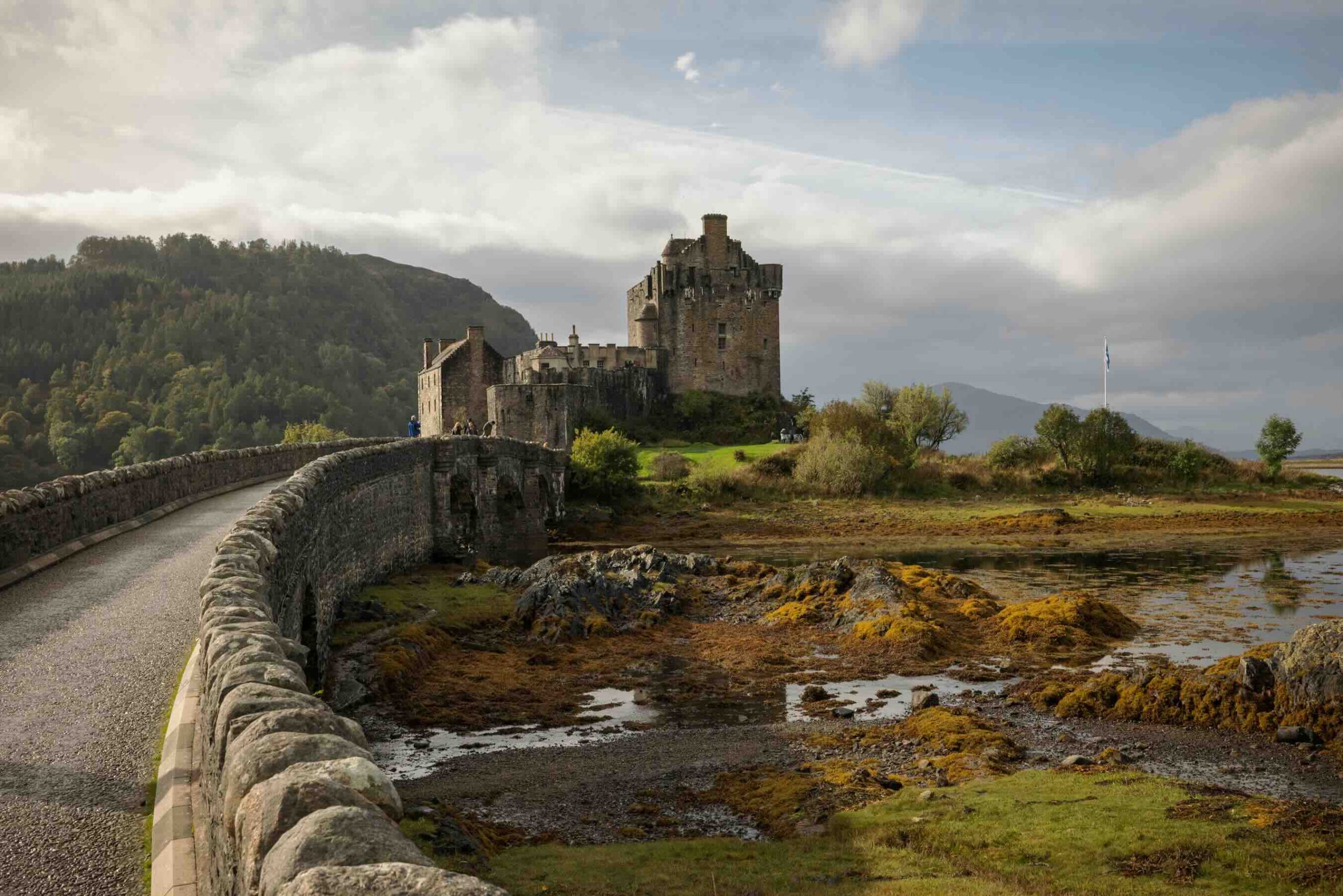
I arrived at Eilean Donan too late and found it closed. I walked around the outside anyway and honestly, that was enough to understand why it appears in so many photographs of Scotland. The castle sits on a small island where three sea lochs meet, with mountains on every side and a stone bridge connecting it to the shore. It looks like it was art-directed.
Local legend holds that the burial grounds of the mythical Otter King, a shape-shifting beast said to grant any wish in exchange for its freedom, were located near Eilean Donan. I don’t know if that makes it more magical but it certainly makes it more interesting.
If you’re heading to Skye by road, you’ll pass Eilean Donan as well. Learn from my mistake and give yourself enough time to actually go inside.
Loch Ness
I’ll be honest with you: Loch Ness was not what I expected. The first time I saw it was when I visited the section near Fort Augustus, which is a genuinely lovely little town, the kind of mountain-adjacent place where you could happily eat a sandwich by the canal and feel very content. The loch itself, though? On a grey day it is large and dark and somewhat unreadable. Less magical, more ominous.
I went again further along, near Urquhart Castle on the drive toward Inverness and that was better. The ruined castle on the water with the mountains behind it is a proper view and worth the stop.
The Nessie legend goes back nearly 1,500 years, to when a giant beast was said to have leaped out of a lake near Inverness and eaten a local farmer. Whether or not you believe any of it, there is something about staring into that dark water that makes you understand why the story started.
Manage your expectations for the loch itself. But do stop at Urquhart Castle and spend time in Fort Augustus if you are passing through.
Loch Lomond
Loch Lomond is the Loch Ness antidote. Where Ness is dark and brooding, Lomond is truly beautiful: wide and bright, with wooded banks and islands and mountains reflected in clear water. I walked along it and took approximately one thousand photos and felt very peaceful.
In Scottish folklore, selkies, which are shape-shifting creatures who take the form of seals on water and humans on land, are said to dance on the shore on full moon nights.
It is also very accessible from Glasgow, which makes it an easy half-day if you are based in the city. That’s where we drove from!
You can read more about my 1-week Scotland road trip here.
Edinburgh
Edinburgh gets its own full posts on this blog so I won’t duplicate everything here, but as a destination for magical Scotland it absolutely belongs on this list.
The city sits on volcanic rock, its skyline dominated by a castle that has been there in some form since the 12th century. The Old Town is a tangle of closes and wynds, many of which have their own ghost stories and histories of plague, murder and general medieval chaos.
For the witchy specifically, Edinburgh was one of the main stages for Scotland’s witch trials. The Witches’ Well on Castle Hill marks the spot where an estimated 300 people were burned at the stake. The Witchery by the Castle restaurant takes its name from this history and is, incidentally, a brilliant dinner option.
For Harry Potter, Victoria Street is the winding, colourful street most closely associated with Diagon Alley and Greyfriars Kirkyard is the graveyard where gravestones bearing names like Thomas Riddell and William McGonagall sit among the moss.
Read Witchy Edinburgh for the city’s dark and magical side and my Edinburgh 3-day itinerary for everything else.
Harry Potter’s Scotland
The author always imagined Hogwarts as being in the Scottish Highlands, and the films leaned into that fully. A huge amount of the outdoor footage across all eight films was shot in Scotland, which means that if you have done any amount of travelling around the country, you have almost certainly stood in a Harry Potter scene without realising it.
Beyond Edinburgh’s Victoria Street and Greyfriars, here is where to go:
Glenfinnan Viaduct is the big one. The 21-arched viaduct is the Hogwarts Express crossing in Chamber of Secrets, Prisoner of Azkaban and Goblet of Fire. I’ve covered it in its own section above because it’s worth it on landscape grounds alone, but for Potter fans it is unmissable. The Jacobite Steam Train runs the actual route between Fort William and Mallaig from April to October.
Glencoe was used for Hagrid’s Hut and numerous wide exterior shots throughout the series. Again, covered above. The landscape is so dramatic it barely needed any CGI enhancement.
Loch Shiel, near Glenfinnan, served as the Black Lake surrounding Hogwarts in several films. Loch Eilt, a little further along the road, is where you will find Eilean na Moine, the tiny island used as the location for Dumbledore’s grave in Deathly Hallows Part 1. Both are on or very near the road if you are driving the route between Fort William and Mallaig.
Loch Morar, near Mallaig, also stood in for the Great Lake in several scenes. If you are riding the Jacobite you will see most of these from the window, which is part of what makes that train journey feel so worth it.
Book the Jacobite Steam Train or guided Harry Potter location tours through GetYourGuide.
The Women Scotland is Still Fighting to Pardon
This deserves its own section because it is not just history, it’s an ongoing conversation.
Between the 16th and 18th centuries, an estimated 4,000 people were accused of witchcraft in Scotland, with over 1,500 executed. The Witches of Scotland campaign, launched on International Women’s Day 2020, is still working to secure legal pardons, a formal apology for all those accused and a national memorial. The campaign frames it as a women’s rights issue: the accused were overwhelmingly female and the underlying logic of the trials was that women, as the weaker sex, were more susceptible to the devil.
If you want to visit specific sites connected to this history, here is where to go.
North Berwick, East Lothian
The North Berwick witch trials of 1590 implicated over 70 people from East Lothian, accused of witchcraft in the St Andrew’s Auld Kirk on Halloween night and running for two years. King James VI attended the trials personally and later wrote a treatise on witchcraft called the Daemonologie. The town today is a pleasant seaside spot about 40 minutes from Edinburgh, but that history sits underneath it.
Paisley, Renfrewshire
Seven people were hanged then burned on 10 June 1697 in Paisley, the last mass execution for witchcraft in western Europe. A memorial now stands at Maxwellton Cross, where the charred remains were buried. The accused Agnes Naismith cursed everyone present at her trial and their descendants, and for years afterwards every tragedy in Paisley was blamed on her. The memorial inscription reads: Pain Inflicted. Suffering Endured. Injustice Done.
Forfar, Angus
A plaque marks the Town House in Forfar, built on top of the tolbooth where victims of the Forfar witch trials were imprisoned and a memorial to the victims stands near Forfar Loch, just off the path in Forfar Loch Country Park.
The Fife Witches’ Trail
Running along the Fife Coastal Path, this trail commemorates the roughly 380 people in Fife accused of witchcraft during Scotland’s satanic panic. The most famous case is that of Lilias Adie, the Torryburn Witch, who died while awaiting trial and was buried on the mudflats of Torryburn Beach beneath a heavy slab of sandstone to prevent the devil from reanimating her. Her burial place is marked in Torryburn. The trail connects Culross, Valleyfield and Torryburn and is free to walk.
Rosslyn Chapel
I haven’t visited Rosslyn Chapel yet (it is firmly on my list and I mention it in my day trips from Edinburgh post) but it absolutely needs to be here.
Built in 1446, the chapel is covered in cryptic stone carvings: biblical scenes, mythical creatures, pagan Green Men and more than 100 unique designs on the ceiling alone, including the so-called musical cubes that some believe encode a hidden melody in the stonework. There is also the legend of the Apprentice Pillar, carved by a young mason while his master was away in Rome, who was allegedly murdered by the master upon his return out of pure envy.
The chapel became internationally famous after Dan Brown used it as the setting for the climax of The Da Vinci Code, with its supposed connections to the Knights Templar and the Holy Grail. The historians largely disagree with Dan Brown. But even without the conspiracy theories, the building sounds extraordinary. The setting, Roslin Glen just south of Edinburgh, is beautiful in its own right.
It is about 45 minutes from Edinburgh by bus.
Orkney
I haven’t been to Orkney yet. It keeps coming up every time I research magical Scotland and it sounds like another level entirely so it’s going on the list too.
Orkney has Neolithic sites older than the pyramids, standing stones shrouded in mystery and a coastline shaped entirely by myth. The Ring of Brodgar is a Neolithic stone circle that predates Stonehenge. Skara Brae is a remarkably preserved Neolithic village sitting right on the coast.
Orkney was also a hotbed of witchcraft accusations and executions. At St Magnus Cathedral you can look into Marwick’s Hole, the dungeon where those accused of witchcraft were imprisoned and there are guided tours that follow the route of the condemned to the execution site.
Glasgow
Glasgow is actually loud and funny and unpretentious in the best possible way. But it has its moments of magic and mysticism.
The Glasgow Necropolis, a vast Victorian Gothic cemetery on a hill above the city with elaborate tombs and views over the rooftops, is one of those places you end up wandering for longer than you planned. It is free to enter and quite spectacular. If you are in Glasgow and you haven’t been, go.
The city also has the Kelvingrove Art Gallery, which feels like its own kind of magic: a huge red sandstone building full of unexpected things, including a Salvador Dalí and a stuffed elephant, which tells you something about its spirit.
How to Plan a Magical Scotland Road Trip
Most of this list is best done by car. The witch trial sites are scattered across the Lowlands and manageable as day trips from Edinburgh. The big landscape spots like Glencoe and Glenfinnan are all natural stops on a Highland road trip.
My Scotland road trip itinerary covers exactly how to connect them, including where to stay and how many days you need.
For trains and buses between cities, check Omio for schedules and booking.
Accommodation I search on Booking.com 99% of the time.
For guided experiences, including Harry Potter location tours and the Jacobite Steam Train, check GetYourGuide.
Final Thoughts
I’ve been to a lot of places. Scotland is one of a small number I’d describe as truly magical. I know I keep using the word “otherworldly” on a lot of my Scotland posts but I think it’s the perfect way to describe it.
The witch trial history is something that we should continue to talk about. These were women, ordinary local women, killed on the basis of fear and misogyny and medieval paranoia. The campaign to pardon and memorialise them is not just historical tidying-up, it’s necessary!
Go to Scotland. Go more than once. And if you are the kind of person who is drawn to the witchy and the unexplained, you will find that the country meets you there.
FAQ: Magical Places in Scotland
In the sense that it has standing stones, ancient mythology, witch trial history, a monster in a loch, Harry Potter filming locations and landscapes that look computer-generated? Yes, fairly. It is the combination of all of these things in one relatively small country that makes it feel unlike anywhere else.
Subjective, but Isle of Skye comes up most often and based on my own experience, I’d agree. The landscape is so extreme it stops feeling quite real. Glencoe is a close second for sheer atmosphere.
All over the country, but the most significant sites include North Berwick in East Lothian, Paisley in Renfrewshire, Forfar in Angus and Edinburgh. The Fife Witches’ Trail connects several sites along the Fife Coastal Path.
The Witches of Scotland campaign secured a formal apology from the Scottish government in 2022. The campaign is still pushing for legal pardons and a national memorial. As of 2025, the pardons have not yet been granted.
By all accounts, yes. Even setting aside the Da Vinci Code connection, the stone carvings alone justify the trip. It is about 45 minutes from Edinburgh by bus.
For the Highlands, yes. Glencoe, Glenfinnan, Eilean Donan, Skye and Loch Ness are all difficult or impossible to reach comfortably without one. Edinburgh, Glasgow and the Fife Coastal Path are all manageable without a car.
A campaign launched in 2020 by lawyer Claire Mitchell KC and writer Zoe Venditozzi seeking legal pardons, a formal apology and a national memorial for those convicted of witchcraft in Scotland between 1563 and 1736. The Scottish government issued a formal apology in 2022. The campaign for pardons and a national memorial is ongoing.
The main ones are Glenfinnan Viaduct and Loch Shiel (Hogwarts Express and Black Lake), Glencoe (Hagrid’s Hut), Loch Eilt and Eilean na Moine (Dumbledore’s grave) and Edinburgh’s Victoria Street and Greyfriars Kirkyard. The Jacobite Steam Train between Fort William and Mallaig covers most of the Highland locations in one journey.
Enjoyed this? You might also like:
- Witchy Edinburgh: The Dark Side of Scotland’s Capital
- Scotland Road Trip Itinerary
- Isle of Skye Travel Guide