This is a post about the best British food in London.
The UK’s food scene is a glorious mash-up of centuries-old traditions and bold modern reinventions. From humble pies to elegant roasts and curries that changed British cuisine forever, eating your way through the capital is one of the most rewarding ways to experience it.
Although one of my favourite things about London is the diversity and the fact I can get food from almost all over the world, I know when I travel one of my favourite things to do is to try the local food. Hence here I am putting together this guide to the best British food in London so you too can try the best local food when you visit. Whether you’re after a pub classic, a Michelin-starred experience or a cheap comforting plate that feels homey, this is your ultimate guide to the best British food in London: what to eat, where to find it, and the stories behind it.

Iconic British Meals to Try in London
Look, I LOVE food!! I love eating, trying new dishes…one of my favourite things in life is to get together with good people and share great food and great chats. It’s also one of my favourite ways of connecting with different cultures. There’s so much more to food than just fuel! Coming from Brazil, it’s literally a love language. I’ll never forget one of my visits home, my boyfriend was on his 3rd plate because the food was so delicious and my mom turned to me and said “Vi, I don’t think he’s eating much”. I told him that and he exclaimed a shocked “WTF?” 😂 But it’s through food and feeding that we truly show love back home. And many other cultures feel the same way but that’s a topic for another post. (Am I an Anthony Bourdain fan? Well, yes, yes I am!)
Anyway, where I was trying to get to was that I love eating foods from all over the world and I have many favourites. British is not one of them. British cuisine is not exactly popular…HOWEVER, it is hearty, honest and comforting; the kind of food that warms you up on a rainy afternoon. Let’s not forget the UK brought us the wonderful, wholesome world of the Great British Bake Off where they often bake many other British goodies.
These dishes below shaped the nation’s identity and, of course, you’ll find them all in London.
READ MORE:
TL,DR:
Full English Breakfast
The fry-up is the great British equaliser: loved by everyone from builders to bankers. It dates back to the 13th century when wealthy households served lavish breakfasts of meat, eggs and bread to show off their hospitality. During the Industrial Revolution, it became a working-class staple, fuelling labourers for long days. Today you’ll find eggs, sausage, bacon, beans, mushrooms, grilled tomatoes and toast. Sometimes black pudding too, if you’re brave.
Many cafés offer variations of it such as vegetarian and vegan. When my brother first came to visit we went to a little spot in Liverpool so he could have a go. I actually spotted a mediterranean version and went for that – it was so delicious! Ok, not very British, but still… you might be travelling with non-meat eaters so it’s good to know you can find other options.
Where to try it:
- The Regency Café, Westminster – famous for its Art Deco look and film appearances (Layer Cake, Brighton Rock).
- E. Pellicci, Bethnal Green – family-run since 1900, buzzing with locals and full of character.
- Pretty much any café, to be honest! Some chains for those who appreciate it are the Breakfast Club and Bill’s.
Fish and Chips
Arguably the most famous dish from London, fish and chips first appeared in the 1860s when Jewish immigrants introduced fried fish and French immigrants brought fried potatoes. Together they became the national dish of a working nation — cheap, filling and delicious. During both World Wars, it was one of the few foods not rationed, cementing its place in British hearts. The perfect portion comes with crispy batter, chunky chips, mushy peas, salt, vinegar and maybe a pint on the side.
Look, I prefer my chips Dutch/Belgian-style covered in mayo (although Ranch is even better!), but I have given the vinegar thing a go and it’s really good! You should try it.
Where to try it:
- Rock & Sole Plaice, Covent Garden – one of London’s oldest fish and chip shops (since 1871).
- Poppies, Spitalfields or Camden – nostalgic décor and award-winning fish.
- The Golden Hind, Marylebone – a 100-year-old classic.
- Golden Union, Soho – huge portions at reasonable prices.
Sunday Roast
The Sunday roast is more than a meal, it’s a ritual. The tradition started in the 15th century when King Henry VII’s royal guards dined on roast beef every Sunday, earning the English their “Roast Beef” nickname abroad. Expect roasted meat, crispy potatoes, veg, gravy and the star of the show: Yorkshire pudding, created to soak up all that gravy.
Nowadays you can actually find Yorkshire pudding wraps at some food markets and they’re super popular too! It’s kinda like a burrito but the wrap is a giant Yorkshire pudding and inside is everything you’d find in a roast: your choice of meat, veggies and gravy!
Where to try it:
- Blacklock Soho – there are some branches around town and, although it’s not really a pub, their roasts are super popular!
- The Holly Bush – possibly one of the most popular pubs in London. Out of the way if you’re just staying central but you should really go for a wander in Hampstead…it’s gorgeous! Besides, you might bump into a Spice Girl or two
- The Harwood Arms, Fulham – the only Michelin-starred pub in London.
- Camberwell Arms, South London – famous for generous platters and relaxed vibes.
Honestly, most pubs that serve food will have it on a Sunday. It’s just not all of them will be good. Remember Nomadic Matt’s rule of not eating within 3 blocks of a tourist attraction!
Pie and Mash
This is pure British comfort food. It took off in the East End in the 1800s when cheap minced meat was wrapped in pastry and paired with parsley liquor, a green gravy made from the water used to cook eels. Jellied eels might not be everyone’s cup of tea, but they were once a Cockney staple.
Where to try it:
- M. Manze, Peckham – the oldest pie shop in London (est. 1902).
- Goddards at Greenwich – family-run since 1890, with meat and veggie pies under £8.
- Mother Mash, Soho – build-your-own pies and mash combos.
Bangers and Mash
If you’re not familiar with the term, “bangers” means “sausage”. It came about during World War I when sausage meat was stretched with water due to shortages making them literally explode in the pan. They’ve come a long way since then, now made with high-quality pork and served with creamy mash and rich onion gravy.
Where to try it:
- Mother Mash, Soho – choose from several types of sausages and gravy.
- The Duke of Cambridge, Islington – organic and locally sourced.
Beef Wellington
This is possibly one of the greatest pieces of British culture. Likely THE BEST British food in London and anywhere else in the country. The show-stopping Beef Wellington is one of Britain’s most elegant dishes – beef tenderloin wrapped in puff pastry with mushroom duxelles and pâté. Though its name honours the Duke of Wellington, who defeated Napoleon at Waterloo in 1815, food historians think it may have been inspired by French cuisine and simply “rebranded” to sound patriotic. Whatever its origin, it’s a masterpiece.
Where to try it:
- Gordon Ramsay’s Savoy Grill – the most famous Wellington in London.
- Hawksmoor, multiple locations – rich and perfectly cooked.*
- The Windmill, Mayfair offers comforting steak pies with a similar flavour profile.
*Hawksmoor is one of the best restaurants around for meat if not the best. It IS pricey! But definitely worth it if you’re after an experience more than just a meal.
Shepherd’s Pie and Cottage Pie
These pub classics date back to the 1700s when nothing went to waste. Cottage pie used leftover beef, while shepherd’s pie used lamb, topped with mashed potatoes to make a complete meal. It’s British thriftiness at its tastiest. Peak comfort food!
Where to try it:
- Rules, Covent Garden – London’s oldest restaurant (1798) and still one of the best for traditional pies.
- The Guinea Grill, Mayfair – perfect old-school comfort food.
Chicken Tikka Masala – Britain’s Real National Dish
Despite its Indian roots, Chicken Tikka Masala is often called the true national dish of Britain. The story goes that in the 1970s, a customer in Glasgow complained that his chicken tikka was too dry, prompting the chef to improvise a sauce using tomatoes, cream and spices, creating the rich orange curry we know today. Some say the sauce was invented to please British palates craving “gravy with their meat.”
It’s a perfect symbol of modern Britain: born from South Asian culinary genius and British taste for comfort. In 2001, then-Foreign Secretary Robin Cook even called it “a true British national dish” because it represented multiculturalism at its best. (where has that sentiment gone?!)
Where to try it:
- Gymkhana, Mayfair – Michelin-starred fine dining with exquisite tandoor dishes.
- Brick Lane, East London – the heart of London’s curry scene, packed with Bangladeshi and Indian restaurants. Try City Spice or The Famous Curry Bazaar for affordable, authentic meals.
Now, although they don’t serve Tikka Masala, I would be remiss if I talked about both Indian food and best food in London if I didn’t mention Dishoom. An Indian restaurant inspired by the old Irani cafés of Bombay bringing Persian influence to its delicious food, it’s become one of the main staples in the London food scene. It’s a hype for a reason. The restaurants are beautiful, the food is gorgeous and the sharing plates makes for a wonderful dining experience.
You’ll find a few of them around town, including Covent Garden where you’ll no doubt visit!
Traditional British Snacks and Street Food
Not every British classic comes on a plate. Some of the nation’s most beloved bites were born in pubs, markets or seaside towns, designed for easy eating and big flavour.
Scotch Eggs
A boiled egg wrapped in sausage meat, breaded and fried, one the ultimate pub snacks. It was invented in 1738 by London department store Fortnum & Mason, allegedly as a portable meal for travellers leaving the city.
Where to try it:
- The Harwood Arms, Fulham – their venison Scotch egg is legendary.
- Borough Market – look for Scotch Tails or Ginger Pig for grab-and-go versions.
Cornish Pasty
The Cornish pasty originated in Cornwall’s tin mines. It was designed with a thick crimped crust so miners could hold it with dirty hands and toss the crust away after eating the filling. Traditional fillings are beef, potato, swede and onion, but you’ll find all sorts now. Personally, one of my favourite foods around these shores.
Where to try it:
- The Cornish Bakery, multiple locations.
- West Cornwall Pasty Co, often in big train stations.
- The Pasty Shop, also often in big train stations
Interested in Cornwall? Here’s a guide to the most magical places to visit in Cornwall.
Ploughman’s Lunch
The Ploughman’s is the pub world’s nod to rustic simplicity: bread, cheese, ham, chutney and pickles. It was actually popularised in the 1960s by the Milk Marketing Board to encourage cheese consumption, but it feels timeless.
Where to try it:
- The George Inn, Southwark – a 17th-century coaching inn.
- The Princess Louise, Holborn – Victorian-era pub with old-world charm.
Welsh Rarebit
It’s really just cheese on toast but elevated. Cheddar melted with ale, mustard and Worcestershire sauce. The name “rarebit” was a tongue-in-cheek jab at the Welsh for eating cheese instead of rabbit.
Where to try it:
- St. John Bread & Wine, Spitalfields – simple, perfect version.
- Fortnum & Mason, Piccadilly – a fancier twist with truffle.
Sausage Roll
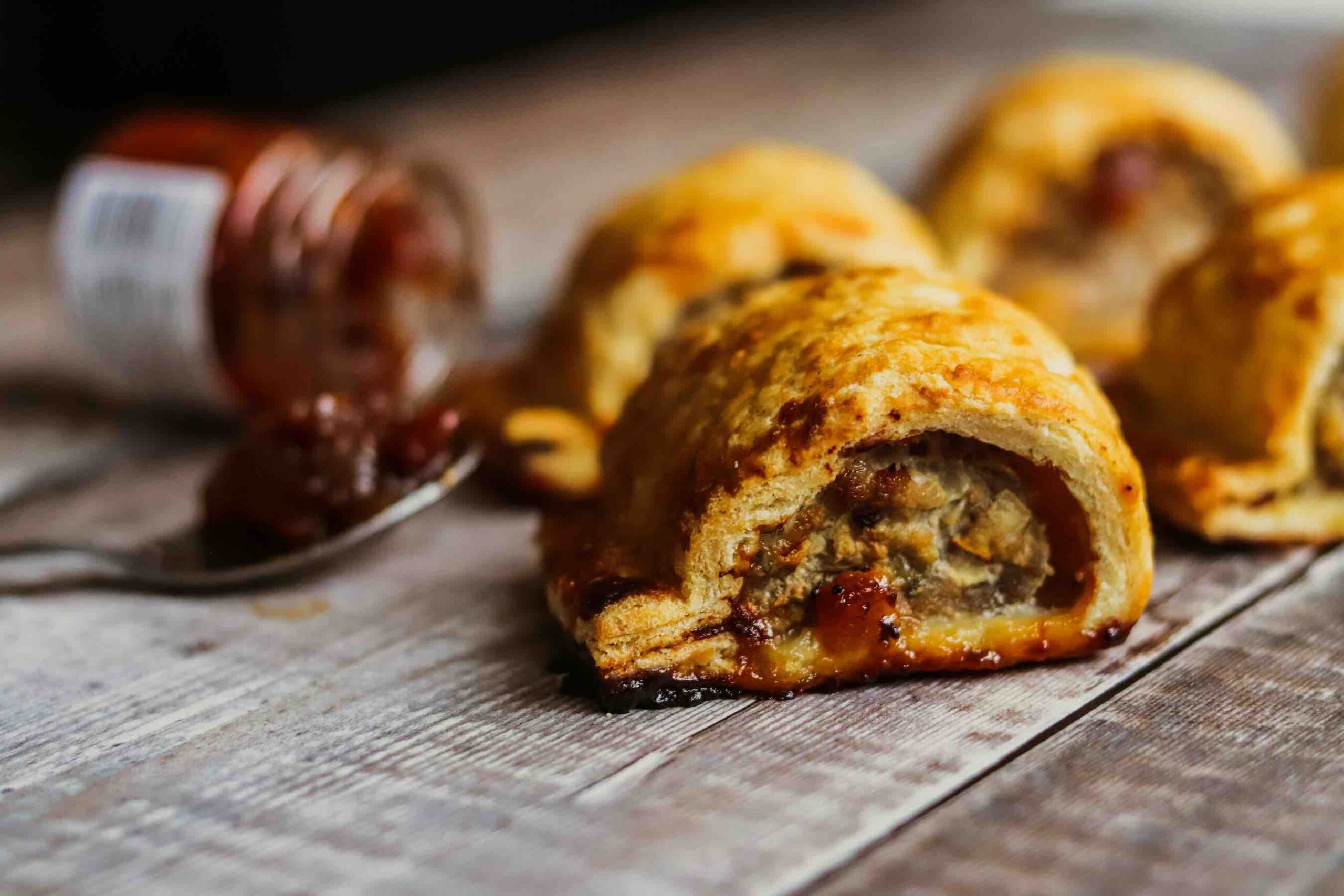
Few foods are as quintessentially British as the humble sausage roll. Golden, flaky pastry wrapped around seasoned sausage meat, it’s the snack of choice for office workers, builders and school kids alike. The concept dates back to 19th-century London, where it appeared as a cheaper, handheld cousin to the meat pie. In fact, early versions were inspired by French pâté-filled pastries but quickly took on their own identity once the British swapped the pâté for pork.
Sausage rolls became a bakery staple across the UK thanks to their convenience and low cost – perfect for a quick lunch on the go. They’ve even had an unlikely glow-up in recent years, appearing in gourmet bakeries with everything from truffle oil to plant-based fillings.
Where to try it:
- The Ginger Pig, Borough Market – renowned for its buttery pastry and high-quality meat.
- St. John Bakery, Neal’s Yard – elevates the classic with flaky perfection.
- Any good bakery or café – you’ll find them almost everywhere in London, still warm from the oven. The Gail’s one is insanely delicious! While you’re at it, grab one of their cheddar and chive scones for more Britishness!
- GREGGS!!!!!!!!! I cannot talk about sausage rolls without mentioning Greggs, a true British institution. Much more than a food provider, it’s an intrinsic part of the very fibre of British culture… best of all, you’ll find it in every corner AND it’s low cost!
British Desserts and Sweet Treats
British desserts are unapologetically indulgent. Often sticky, steamy and nostalgic. Most were created from simple ingredients during frugal times, but their charm has endured.
Sticky Toffee Pudding
If there’s one on the menu, I probably won’t even bother looking at the other options. That’s how much I love a sticky toffee…. Believed to have originated in Cumbria in the 1970s, sticky toffee pudding is a modern classic: a date sponge drenched in warm toffee sauce. Best topped with vanilla ice cream. It’s the dessert equivalent of a hug.
Where to try it:
- The Ivy, Covent Garden – indulgent and beautifully served.
- Blacklock, Soho – best after their famous Sunday roast.
Eton Mess
Created accidentally at Eton College when a meringue pudding was dropped during a cricket match, this messy mix of strawberries, cream and meringue became an instant hit.
Where to try it:
- Rules, Covent Garden – traditional and beautifully presented.
- The Wolseley, Piccadilly – refined yet nostalgic.
Afternoon Tea and Scones
The most British tradition of all. Afternoon tea was introduced in the 1840s by Anna, the Duchess of Bedford, who wanted a snack between lunch and dinner. Scones with clotted cream and jam became its crowning glory.
Where to try it:
- The Ritz, Mayfair – classic luxury afternoon tea.
- Claridge’s or Sketch, Mayfair – elegant with a creative twist.
- Tea & Tattle near the British Museum or The English Rose Café near Buckingham Palace for a more budget option
I have to be honest, I find these usually very overpriced. I think you pay more for the experience as the food falls on the side of boring (in my opinion!! So I’ll sit this one out but, if that’s something you want to try, please by all means do! I’m just giving you a bit more info to play with but please make yourself happy! Don’t let me stop you.)
Eating British on a Budget in London
You don’t need a royal budget to eat well in London. Visit Borough Market, Camden Market or Greenwich Market for affordable British classics. Many pubs offer weekday lunch menus under £20, often including a drink. Supermarkets like M&S and Waitrose have dine-in-for-£10 deals if you’re self-catering. You can also find discounted afternoon tea experiences on GetYourGuide.
I’ve actually got a whole London food guide here breaking down different eateries by budget. And if you’re into street food like me, I’ve also got a guide to London’s best food markets where you can find not only some of these iconic British staples but also many other cuisines!
Final Thoughts
British food is steeped in history yet constantly evolving. London captures that perfectly — from centuries-old pie shops in Peckham to Michelin-star curry houses in Mayfair. Whether you’re indulging in Beef Wellington at The Savoy, fish and chips in Covent Garden or a £10 pie in Greenwich, every bite tells a story of how tradition meets innovation in Britain’s culinary capital.
This is a post about the best British food in London.